
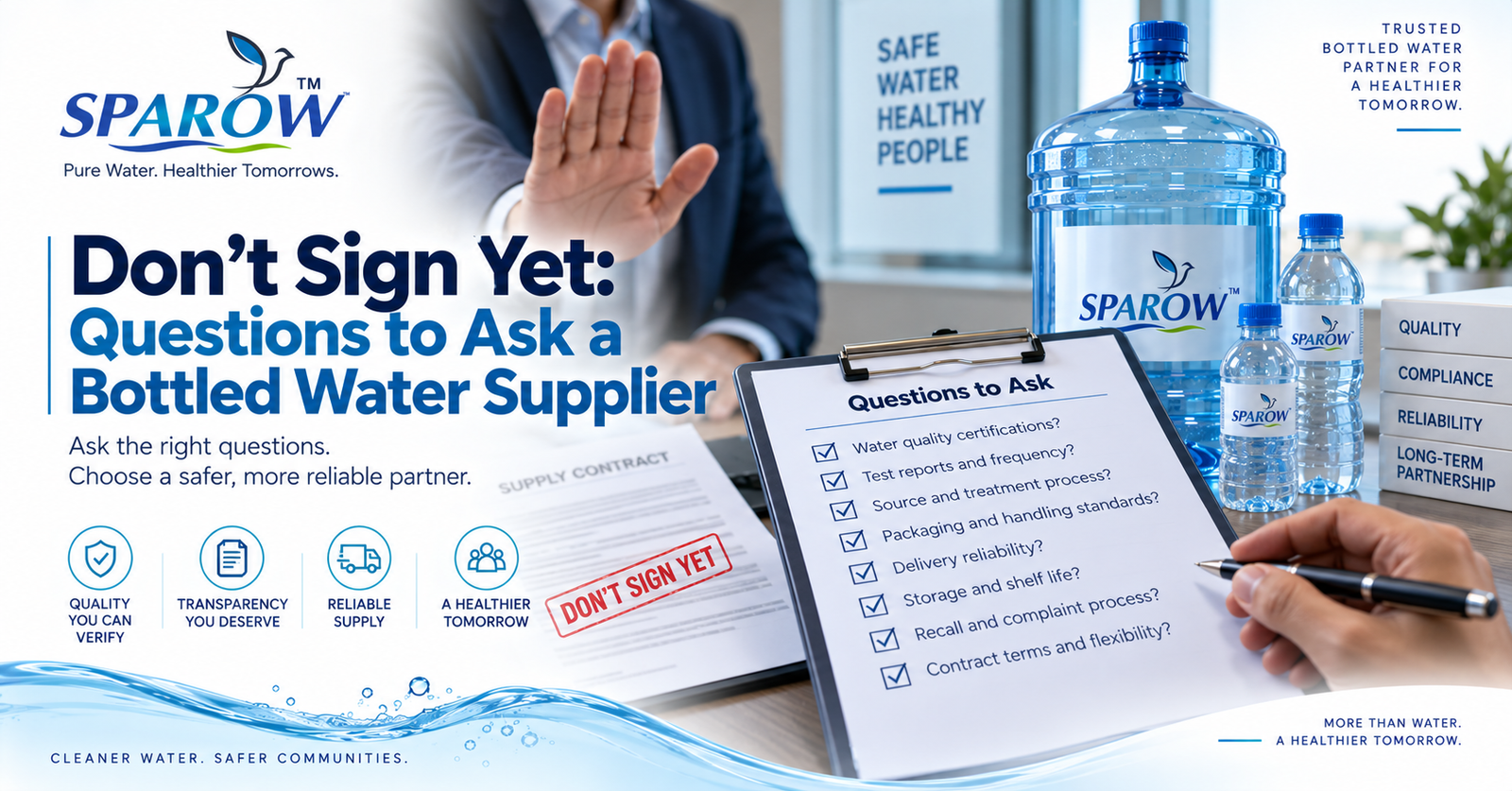
Your staff, students, guests or customers drink this water every single day. Before you sign a supply agreement, you need to know exactly what you are paying for. The right questions to ask a bottled water supplier before signing a contract protect you from unsafe water, missed deliveries and surprise charges.
Many businesses in Tamil Nadu choose a water can supplier based only on the price per can. That decision feels fine until a delivery fails in the middle of May, or a can arrives with a broken seal. Changing suppliers mid-contract is painful, and sometimes expensive.
This guide gives you 40 practical questions, grouped by topic. It also covers what a good answer sounds like, which red flags to watch for, and a checklist you can print. It is written for offices, schools, hotels, hospitals, event organisers and distributors across South Tamil Nadu.
Who wrote this: This guide is from Brawin Rajadurai, founder of RD Reigrow Private Limited, the company behind SPAROW packaged drinking water. It draws on what B2B buyers across South TamilNadu actually ask before they commit to a supplier.
Table of Contents
What Should You Ask a Bottled Water Supplier?
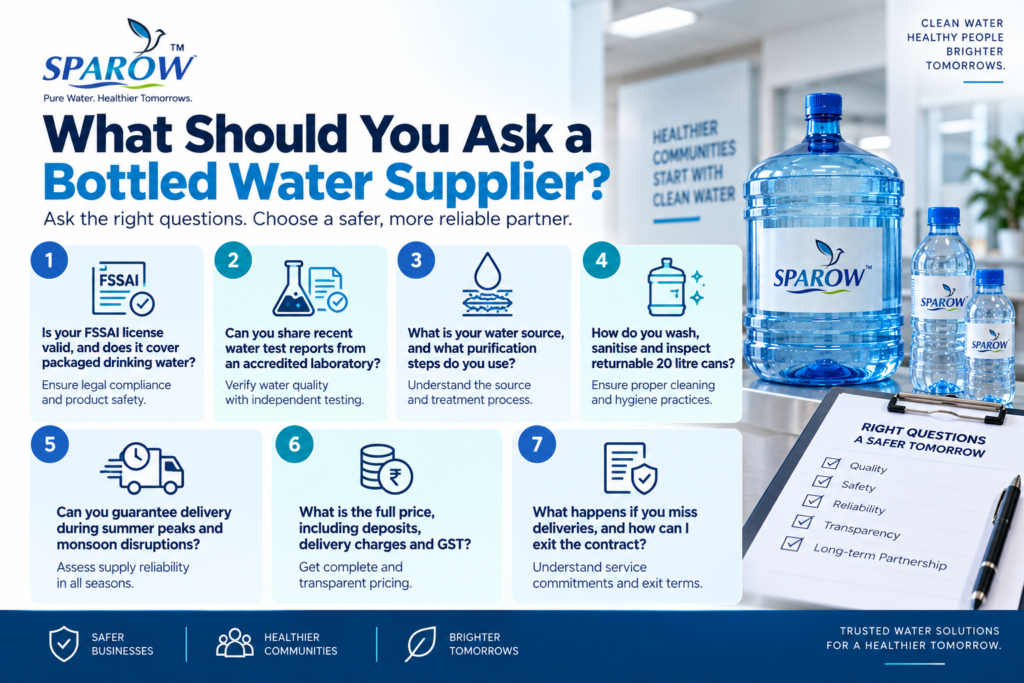
- Is your FSSAI license valid, and does it cover packaged drinking water?
- Can you share recent water test reports from an accredited laboratory?
- What is your water source, and what purification steps do you use?
- How do you wash, sanitise and inspect returnable 20 litre cans?
- Can you guarantee delivery during summer peaks and monsoon disruptions?
- What is the full price, including deposits, delivery charges and GST?
- What happens if you miss deliveries, and how can I exit the contract?
The sections below break each area into detailed questions you can take into a supplier meeting.
Why These Questions Matter Before You Sign
Drinking water is a food product in India. That means quality problems affect health, not just comfort. A single bad batch can cause stomach illness among staff or guests and damage your reputation.
A contract also locks you in. Once you have paid can deposits and agreed to a term, switching suppliers takes time and money. Asking the right questions upfront is far cheaper than fixing a bad decision later.
The real cost of a poor supplier
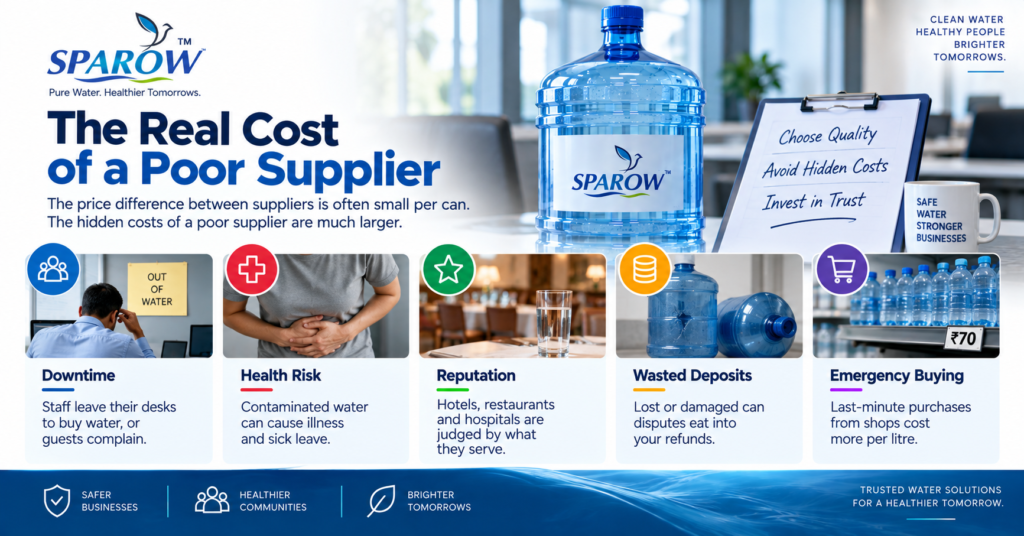
The price difference between suppliers is often small per can. The hidden costs of a poor supplier are much larger:
- Downtime: Staff leave their desks to buy water, or guests complain.
- Health risk: Contaminated water can cause illness and sick leave.
- Reputation: Hotels, restaurants and hospitals are judged by what they serve.
- Wasted deposits: Lost or damaged can disputes eat into your refunds.
- Emergency buying: Last-minute purchases from shops cost more per litre.
Why South Tamil Nadu buyers need extra care
Water demand in cities like Tirunelveli, Thoothukudi, Madurai and Virudhunagar rises sharply during the hot months from March to June. Suppliers stretched thin in summer may prioritise bigger clients or skip routes. During the northeast monsoon from October to December, heavy rain can disrupt roads and delivery schedules.
Groundwater quality also varies from area to area across the region. A supplier’s purification process matters more when the raw water source varies. That is exactly why the questions to ask a bottled water supplier before signing a contract must go beyond price.
Questions to Ask a Bottled Water Supplier Before Signing a Contract About Licensing and Compliance
Start here. If a supplier cannot answer these clearly, you do not need to ask anything else.
1. Do you have a valid FSSAI license for packaged drinking water?
What to look for: A clear yes, with the license number shared without hesitation.
Every food business in India, including packaged drinking water manufacturers, must hold FSSAI registration or a license. Ask for a copy of the license certificate. Check that the product category includes packaged drinking water.
2. Can I verify your license number online?
What to look for: A 14-digit FSSAI number that you can check yourself.
You can verify FSSAI license details on the FSSAI’s FoSCoS portal. Confirm three things: the license is active, the expiry date has not passed, and the business name matches the company you are signing with.
Tip: Match the label, the license and the invoice
The FSSAI number printed on the can label should match the license certificate. The company name on the license should match the name on your invoices and contract. A mismatch may mean the supplier is only a reseller for another brand, and you need to know that.
3. Are you the manufacturer or a distributor?
What to look for: An honest answer either way.
Distributors can be excellent partners, especially for local delivery. However, you should know which plant produces the water. Ask for the manufacturer’s name and FSSAI details as well.
4. How often do you test your water, and where?
What to look for: Regular in-house testing plus periodic testing at an external accredited laboratory.
Ask how often batches are checked in-house. Then ask how often samples go to an NABL-accredited lab. A supplier with a consistent testing routine will describe it without needing to look anything up.
5. Can you share your most recent lab test report?
What to look for: A recent report, dated within the last few months, from an identifiable laboratory.
Look at the date, the lab’s name and the parameters tested. These usually include physical, chemical and microbiological parameters. If the report is old, blurry or has no lab name, treat that as a warning sign.
6. Have you had any food safety notices or product recalls?
What to look for: Transparency.
No supplier likes this question, but a trustworthy one will answer it honestly. If an issue happened in the past, ask what they changed afterwards. How a supplier handled a problem tells you a lot.
Questions About Water Source and Purification
Clean-looking water is not always safe water. These questions help you understand what happens before the water reaches your can.
7. What is your raw water source?
What to look for: A specific answer, such as a borewell at the plant or a municipal supply.
Suppliers use borewells, open wells, municipal supply or tanker water. Each source carries different risks. A supplier who knows their source well also knows how to treat it.
8. What purification stages do you use?
What to look for: A step-by-step explanation.
Most packaged drinking water plants use a combination of these stages:
| Stage | What it does |
|---|---|
| Sand and carbon filtration | Removes suspended particles, odour and some chemicals |
| Micron filtration | Captures fine particles before RO |
| Reverse osmosis (RO) | Reduces dissolved salts and many contaminants |
| UV sterilisation | Inactivates bacteria and other microorganisms |
| Ozonation | Disinfects the water and helps keep it safe in the sealed container |
A supplier does not need every stage listed here. They should, however, explain why their process suits their water source.
9. What TDS range does your water fall in?
What to look for: A consistent range, and an explanation of how they control it.
TDS means total dissolved solids, which covers the minerals and salts in water. Water with very high TDS can taste salty or heavy. Water stripped of nearly all minerals can taste flat, so many plants add back minerals after RO.
10. Do you add minerals after purification?
What to look for: A clear yes or no, with the reason.
Mineral addition changes taste and consistency. If your staff or guests have complained about taste with a previous supplier, this question matters. Ask whether the mineral dosing is controlled or done by estimate.
11. Can we visit your plant?
What to look for: An open invitation.
A plant visit is the single best way to judge a supplier. Watch the washing area, the filling room and staff hygiene. Suppliers who refuse visits, or only allow them after a long delay, may have something to hide.
What to observe during a plant visit
- Are workers wearing caps, gloves and clean clothing?
- Is the filling area enclosed and separated from the washing area?
- Are empty cans stored off the floor and away from dust?
- Is there a visible quality testing area?
- Are batch records maintained and easy to show?
Questions About Packaging, Cans and Hygiene
For most businesses, the 20 litre returnable can is the main product. Because these cans come back and get refilled, hygiene is the biggest risk in the whole supply chain.
12. How do you clean returnable 20 litre cans?
What to look for: A multi-step process, not just a rinse.
A good process usually includes an inspection, an external wash, an internal wash with a cleaning solution, a rinse with treated water and sanitisation. Ask whether washing is automated or done by hand. Also ask how the supplier checks that each can is actually clean.
13. When do you reject and replace old cans?
What to look for: A defined rule for scratched, cracked, discoloured or smelly cans.
Cans wear out with repeated use and handling. Scratches inside a can make it harder to clean. A responsible supplier removes damaged cans from circulation instead of refilling them.
14. Does every can have a tamper-proof seal?
What to look for: A shrink-wrapped cap seal on every can.
The seal shows the can has not been opened after filling. Train your staff to refuse any can with a broken, loose or missing seal. Include this refusal right in your contract.
15. Is every can labelled with a batch number and dates?
What to look for: A batch or lot number, a packing date and a best before date on each can.
Batch numbers make it possible to trace a problem back to a specific production run. Without them, complaints turn into arguments. Labels should also show the FSSAI license number.
16. What container material do you use?
What to look for: Food-grade material, with the supplier able to name it.
Large 20 litre cans are commonly made from polycarbonate or PET. Smaller 1 litre and 0.5 litre bottles are usually PET. Ask how the cans are stored during transport, because long exposure to direct sunlight is not good for water or containers.
17. Do you supply other pack sizes?
What to look for: Options that match how you actually use water.
Offices may need only 20 litre cans. Hotels, events and meeting rooms often need 1 litre or 0.5 litre bottles as well. Using one supplier for all sizes simplifies billing and accountability.
Questions About Supply Capacity and Delivery Reliability
A supplier with good water but unreliable delivery still fails you. These questions show whether they can keep their promises when demand spikes.
18. What is your daily production capacity in litres?
What to look for: A specific number, and a sense of how much of it is already committed.
If your business needs 400 litres a day, that is 20 cans of 20 litres each. Compare that to the supplier’s capacity and their existing client load. A supplier running at full capacity has no room for your extra orders.
19. How do you handle demand in April and May?
What to look for: A real plan, such as extra shifts, stored stock or additional vehicles.
The summer months put huge pressure on every supplier in Tamil Nadu. Ask directly whether existing contract clients get priority over walk-in orders. Get that priority written into your agreement.
20. What happens to deliveries during heavy rain or floods?
What to look for: A backup plan for the northeast monsoon.
Ask whether they keep stock at a nearby depot, or allow clients to hold a buffer of extra cans. Coastal areas like Thoothukudi, Kanyakumari and Ramanathapuram can see sudden disruption. A supplier who has never thought about this will struggle when it happens.
21. What is the delivery schedule, and can it be changed?
What to look for: Fixed days and time windows, with flexibility for urgent needs.
Agree on specific delivery days and times. For example, a school might want deliveries before morning assembly. An office may prefer mid-morning to avoid lobby crowding.
22. How quickly can you deliver an emergency order?
What to look for: A committed response time, such as same day or within a set number of hours.
Unexpected guests, a function or a sudden heatwave can double your consumption. Ask what the fastest turnaround is. Then ask whether emergency orders cost extra.
23. How many delivery vehicles and staff serve my area?
What to look for: More than one vehicle covering your route.
A supplier with a single van is one breakdown away from missing your delivery. Ask where their nearest warehouse or plant is located. Shorter distances usually mean more reliable service.
24. Will delivery staff carry cans inside and load the dispenser?
What to look for: A clear answer on what is and is not included.
Some suppliers leave cans at the gate. Others carry them to each floor and place them on dispensers. This matters a lot for multi-storey offices, hospitals and schools.
Questions About Pricing, Deposits and Payment Terms
Price per can is only one line on the bill. Ask these questions to understand what you will really pay every month.
25. What is the price per 20 litre can, and what does it include?
What to look for: A single, clear number with everything listed.
Clarify whether the price includes delivery, loading and GST. Then calculate the price per litre, so you can compare suppliers fairly. Divide the can price by 20 to get the cost per litre.
26. Is GST included in the quoted price?
What to look for: A written quote showing the GST separately.
Some quotes look cheaper because GST is added only on the invoice. Ask for a GST invoice every month so you can claim input tax credit where eligible. Confirm the applicable GST rate with your accountant, because rates can change.
27. How much is the can deposit, and when is it refunded?
What to look for: A refundable deposit per can, with written refund terms.
Ask how the deposit is recorded and how quickly it will be refunded when you exit. Also ask who is responsible if a can is damaged or lost. Clear rules here prevent disputes at the end of the contract.
28. Is there a minimum order quantity?
What to look for: A minimum that matches your actual usage.
Some suppliers demand a fixed number of cans per week. That works for steady users but hurts seasonal businesses like schools during vacation. Ask whether the minimum can be paused during holidays.
29. Do you offer volume or long-term discounts?
What to look for: Tiered pricing based on monthly litres.
Larger buyers, such as hospitals, factories and distributors, should negotiate. Ask for the price at different volume levels. Get the pricing slabs written into the contract.
30. How and when can you increase prices?
What to look for: A price revision clause with notice and limits.
Costs for fuel, electricity and packaging do change. A fair contract requires advance written notice before any increase. It should also give you the right to exit if you do not accept the new price.
31. What are the payment terms?
What to look for: Options such as monthly billing, credit periods, and accepted payment methods.
Businesses usually prefer monthly invoicing with a credit period. Clarify the due date, late payment charges and whether UPI or bank transfer is accepted. Avoid suppliers who insist on large advance payments.
Sample price comparison worksheet
| Item | Supplier A | Supplier B | Supplier C |
|---|---|---|---|
| Price per 20 litre can | |||
| Price per litre | |||
| GST included? | |||
| Delivery charge | |||
| Deposit per can | |||
| Minimum order | |||
| Credit period | |||
| Monthly cost for your usage |
Fill this in using each supplier’s written quotes. The cheapest can price does not always produce the lowest monthly cost.
Questions About Contract Terms, Penalties and Exit Clauses
This is where many buyers lose money. Read the agreement slowly, and do not sign until every answer below is written in it.
32. How long is the contract term?
What to look for: A reasonable term, with the option to renew.
A long lock-in with a new supplier is risky. Many buyers start with a shorter trial period before committing to a longer term. This lets you test quality and reliability with lower risk.
33. What is the notice period to end the contract?
What to look for: A fair notice period that applies equally to both sides.
Check whether you can exit early for poor service. The contract should allow termination if quality or delivery commitments are repeatedly broken. Also check whether any cancellation fee applies.
34. What happens if you miss a delivery?
What to look for: A written service commitment with a remedy.
Remedies may include a discount, a free can or a credit on the next invoice. Without a written remedy, a missed delivery costs the supplier nothing. That removes their incentive to be reliable.
35. What happens if a can is found unsafe?
What to look for: Immediate replacement and a clear investigation process.
Visible particles, bad smell, algae, a broken seal or an expired date are all valid reasons to reject a can. The contract should state that rejected cans are replaced at no cost. It should also state how quickly the supplier will respond.
36. Who provides and maintains the water dispensers?
What to look for: Clear ownership, cleaning schedules and repair responsibilities.
A clean can on a dirty dispenser still gives dirty water. Ask whether dispensers are provided, rented or bought. Then ask who cleans and sanitises them, and how often.
Callout: Put everything in writing. Verbal promises about priority delivery, free replacement or fixed prices mean nothing in a dispute. If a supplier agrees to something in a meeting, ask them to add it to the contract before you sign.
Questions About Customer Service and Complaint Handling
Even good suppliers make mistakes. What matters is how fast and fairly they fix them.
37. Who is my single point of contact?
What to look for: A named person with a direct phone number.
A general helpline is not enough for a business account. You need someone who knows your account and can make decisions. Also ask who to call if that person is unavailable.
38. How do I raise a complaint, and how fast will you respond?
What to look for: A defined complaint process and a committed response time.
Ask whether complaints can be raised by phone, WhatsApp or email. Record every complaint with the batch number and a photo. This creates a clear record if the contract ever needs to be ended.
39. Can you give me references from current business clients?
What to look for: Two or three contactable references similar to your business.
Call them. Ask about delivery reliability during summer, how complaints were handled and whether they would sign again. References tell you what sales conversations cannot.
40. How long have you been serving businesses in this region?
What to look for: A track record in your area, and knowledge of local conditions.
A supplier familiar with South Tamil Nadu understands local routes, seasonal demand and customer expectations. That local experience often matters more than a large brand name. For more on how buyers in this region choose water suppliers, read the B2B packaged drinking water insights on Brawin Rajadurai’s blog.
Questions to Ask Based on Your Type of Business
| Business type | Most important questions | Why |
|---|---|---|
| Offices and IT companies | Delivery schedule, carrying cans to floors, dispenser cleaning, monthly billing | Staff convenience and minimal disruption |
| Schools and colleges | Lab reports, can hygiene, holiday pauses, morning delivery times | Children’s health and seasonal usage |
| Hospitals and clinics | Testing frequency, batch traceability, emergency delivery, replacement terms | Patient safety and zero tolerance for failure |
| Hotels and restaurants | Multiple pack sizes, sealed bottles, consistent taste, guest-facing labels | Guest experience and brand image |
| Factories and construction sites | Daily capacity in litres, volume pricing, remote site delivery | Large workforce and high summer consumption |
| Event organisers and wedding halls | Short-notice bulk orders, 1 litre and 0.5 litre bottles, return of unused stock | Unpredictable guest counts |
| Distributors and retailers | Manufacturer details, margins, supply consistency, territory terms | Resale reputation depends on the brand |
Why Hospitals Need Stricter Supplier Checks
Patients, visitors and medical staff all rely on the water you provide, and many patients have weaker immunity than healthy adults. That is why hospitals and clinics should ask for recent lab reports, batch numbers on every 20 litre can, and a written replacement policy for any unsafe can. Consumption also stays high around the clock, so confirm the supplier can handle emergency orders at short notice. If you manage a healthcare facility, see how to arrange hygienic water delivery for your hospital that meets these standards.
Questions to ask a bottled water supplier before signing a contract for events
Events in South Tamil Nadu are often large and unpredictable. This includes weddings during muhurtham season, temple festivals and corporate functions. Ask whether the supplier accepts unused sealed stock back, how much notice they need, and whether they can deliver on the event day itself.
Questions for distributors considering a water brand
If you plan to resell, you are putting your own name behind the brand. Ask about stock availability in peak season, territory exclusivity and marketing support. Also confirm that the manufacturer’s FSSAI details are printed correctly on every label.
Red Flags: Answers That Should Stop You From Signing
Sometimes the answer to a question matters less than how the supplier responds. Watch for these warning signs.
| Red flag | What it may indicate |
|---|---|
| Cannot share an FSSAI license number | Unlicensed or unverified operation |
| License name differs from the company name | Reseller hiding the real manufacturer |
| No lab reports, or only very old ones | No regular quality testing |
| Refuses a plant visit | Poor hygiene or undisclosed practices |
| Cans with no batch number or dates | No traceability if something goes wrong |
| Price far below every other quote | Corners cut on cleaning, testing or can replacement |
| Refuses to put promises in writing | No accountability later |
| No clear notice period or exit clause | Designed to lock you in |
| Only one delivery vehicle | High risk of missed deliveries |
| No named contact person | Complaints will go unanswered |
Callout: The very cheap quote. Purification, testing, can washing and replacement all cost money. When a quote is far lower than others in your area, ask the supplier to explain exactly how they manage it. If the explanation is vague, walk away.
How to Evaluate a Bottled Water Supplier Step by Step
Knowing the questions to ask a bottled water supplier before signing a contract is only half the job. You also need a simple process to compare answers fairly. Follow these steps.
Step 1: Calculate your water needs in litres
Estimate daily consumption per person, then multiply by headcount and working days. Add a buffer for summer, when consumption rises. Convert the total into 20 litre cans to understand your weekly order.
Step 2: Shortlist three to five suppliers
Ask other businesses nearby who they use. Look for suppliers who serve your specific area of Tamil Nadu. Avoid choosing based on advertisements alone.
Step 3: Verify FSSAI licensing first
Check each supplier’s license on the FSSAI FoSCoS portal before scheduling meetings. Remove any supplier whose license is inactive, expired or does not match. This saves time for everyone.
Step 4: Ask all 40 questions in writing
Send the questions by email or print them for the meeting. Written answers are easier to compare. They also become useful references when you negotiate the contract.
Step 5: Visit the plant
Visit at least your top two suppliers. Use the plant visit checklist in this guide. Try to visit without a lot of advance notice.
Step 6: Order a trial
Place a small trial order for two to four weeks. Check seal quality, labels, taste, delivery timing and staff behaviour. Record every issue.
Step 7: Call references
Speak to at least two current clients of each finalist. Ask specifically about summer and monsoon performance. Ask whether complaints were resolved quickly.
Step 8: Score and compare
Use a simple scoring table. Give each area a score from 1 to 5, and give more weight to safety and reliability than to price.
| Area | Weight | Supplier A | Supplier B |
|---|---|---|---|
| Licensing and testing | 25% | ||
| Hygiene and packaging | 20% | ||
| Delivery reliability | 20% | ||
| Pricing and terms | 20% | ||
| Service and references | 15% |
Step 9: Negotiate and sign
Put every commitment in the contract, including delivery times, replacement terms, price revision notice and exit terms. Read the final draft carefully. Sign only when every key answer is reflected in writing.
Printable Checklist: Before You Sign
Use this checklist as a final review of the questions to ask a bottled water supplier before signing a contract.
Compliance
- FSSAI license verified online and active
- License name matches the contract and invoice
- Recent lab report from an accredited lab received
- Manufacturer identified if the supplier is a distributor
Water quality
- Water source explained
- Purification stages explained
- Plant visited
- Trial order tasted and inspected
Packaging and hygiene
- Can washing process explained
- Tamper-proof seal on every can
- Batch number, packing date and best before date on labels
- Damaged can replacement policy agreed
Delivery
- Daily capacity in litres confirmed
- Summer priority written into the contract
- Monsoon backup plan agreed
- Delivery days, times and emergency response agreed
Pricing
- Price per can and price per litre confirmed
- GST treatment clear
- Deposit amount and refund terms written
- Price revision notice and exit right included
Contract
- Term length acceptable
- Notice period and exit clause clear
- Missed delivery remedy written
- Unsafe can replacement terms written
- Dispenser responsibility clear
- Named point of contact provided
Conclusion: Ask First, Sign Second
Water feels like a simple purchase, but a supply contract affects health, comfort and daily operations for months or years. The right questions to ask a bottled water supplier before signing a contract give you control. They reveal who takes quality seriously, who can deliver in the April heat, and who will stand behind their product when something goes wrong.
Start with FSSAI verification and lab reports, because nothing else matters if the water is not safe. Then test reliability, understand the real monthly cost, and make sure every promise is written into the agreement. A short trial and a plant visit will tell you more than any sales pitch.
Take these 40 questions to your next supplier meeting. The best suppliers will welcome them, and that response alone tells you a great deal.
Looking for a Reliable Packaged Drinking Water Supplier in South Tamil Nadu?
SPAROW packaged drinking water, from RD Reigrow Private Limited, supplies businesses, institutions and distributors across South Tamil Nadu. Bring these questions to us. We will answer each one openly, share our FSSAI details and invite you to see how our water is produced.
Request a quote today through rdreigrow.com, or contact us at contact@rdreigrow.com to discuss your monthly requirement in litres.
FAQs
1. What are the most important questions to ask a bottled water supplier before signing a contract?
The most important questions cover FSSAI licensing, recent lab test reports, water source and purification, can cleaning, delivery reliability and total pricing. You should also ask about exit terms. Among these, start with safety. Verify the FSSAI license and ask for a recent report from an accredited laboratory. Next, confirm the supplier can deliver during peak summer months. Finally, make sure the contract includes clear penalties for missed deliveries and a fair notice period. Always get every answer in writing before you sign.
2. How do I verify a water supplier’s FSSAI license?
Ask the supplier for their 14-digit FSSAI license number and a copy of the certificate. Then check the number on the FSSAI’s FoSCoS portal. Confirm that the license is active and has not expired, and that the business name matches the supplier on your contract and invoices. Also compare it with the license number printed on the can label. If the numbers or names do not match, ask why before continuing. The supplier may be a distributor for another manufacturer.
3. How often should a bottled water supplier test its water?
A reliable supplier tests water regularly in its own plant laboratory and also sends samples to an external accredited laboratory at set intervals. Exact frequency varies between businesses. Ask the supplier to describe their in-house testing routine and show recent external lab reports. A report that is many months old, or one without a laboratory name, is a warning sign. Consistent testing records show the supplier treats quality as an ongoing process rather than a one-time certificate.
4. What should a bottled water supply contract include?
A good water supply contract includes the price per can, GST treatment, deposit amount and refund terms, and delivery days and times. It should also cover minimum order quantity, missed delivery remedies, replacement terms for unsafe cans, and dispenser responsibilities. The contract must state the term length, notice period and the conditions under which you can exit early. It should also include a price revision clause requiring advance written notice. Any verbal promise made during negotiation should be added before signing.
5. How can I tell if a 20 litre water can is safe to use?
Check that the can has an intact tamper-proof seal. Look for a label showing the FSSAI license number, batch number, packing date and best before date. The water should look clear, with no floating particles, colour or smell. Inspect the can body for cracks, heavy scratches or green discolouration, which may suggest algae. Refuse any can that fails these checks and report it to the supplier with a photo and the batch number.
6. Who is responsible for lost or damaged water cans?
This depends entirely on your contract, so settle it before signing. Most suppliers collect a refundable deposit per 20 litre can. Normal wear is usually the supplier’s responsibility, while cans lost or broken at your premises may be deducted from your deposit. Ask the supplier to define damage clearly and describe how deposit refunds are calculated when the contract ends. Keeping a simple record of cans received and returned helps prevent disputes.
7. Is the cheapest water supplier a good choice for businesses?
Not always. Purification, testing, can washing and replacing old cans all cost money. A price far below other quotes in your area may mean the supplier is cutting corners on hygiene or quality. Compare suppliers on total monthly cost, including delivery charges, deposits and GST. Weigh that against safety, reliability and service. A slightly higher price from a dependable, FSSAI-licensed supplier is usually far cheaper than dealing with illness, complaints or missed deliveries.
8. How much water does an office need per day?
Consumption varies with the season, the type of work and whether water is also used for tea, coffee or cooking. The easiest method is to track your actual usage for two to four weeks with a trial order. Then add a buffer for summer, when consumption in Tamil Nadu rises noticeably. Convert your daily litres into 20 litre cans to plan weekly orders. Share this estimate with suppliers so they can confirm their capacity.
9. Should I sign a long-term water supply contract?
A long-term contract can bring better pricing and priority delivery, but it also increases your risk if the supplier underperforms. Start with a short trial period, then move to a longer term once quality and reliability are proven. Whatever the length, make sure the contract lets you exit early if quality or delivery commitments are repeatedly broken. It should also include a fair, equal notice period for both parties.
10. What should I do if my water supplier delivers poor quality water?
Stop using the affected cans immediately and keep them sealed for inspection. Photograph the can, the label and the batch number, then report the issue to your supplier contact in writing. Your contract should require quick replacement at no cost. If problems repeat, use your contract’s termination clause. Serious food safety concerns can also be reported to the Tamil Nadu Food Safety and Drug Administration Department or through FSSAI’s consumer grievance channels.
External Sources
- Food Safety and Standards Authority of India (FSSAI): Use it for packaged drinking water regulations and labelling rules.
- FSSAI FoSCoS portal: Use it to show readers how to verify FSSAI license numbers.
- World Health Organization (WHO): Use its Guidelines for Drinking-water Quality for general safety principles.
- National Accreditation Board for Testing and Calibration Laboratories (NABL): Use it to explain accredited water testing laboratories.
- Tamil Nadu Water Supply and Drainage Board (TWAD Board): Use it for regional water supply and quality context.
Choosing a water supplier for your business? Start with the right partner.
SPAROW packaged drinking water serves offices, schools, hospitals, hotels, events and distributors across South Tamil Nadu. Ask us every question on this list, and we will answer openly.
- Request a quote: Share your monthly requirement in litres through rdreigrow.com.
- Email us: contact@rdreigrow.com
- Read next: How to check an FSSAI license for packaged drinking water
- Subscribe: Get practical B2B water supply insights from Brawin Rajadurai’s blog