
Every hospital in South Tamil Nadu runs on water it rarely tests properly. A hospital drinking water quality standards checklist is the one document that turns that blind spot into a controlled process — and most hospitals in Tirunelveli, Madurai and Thoothukudi do not have one.
The problem is not indifference. It is that nobody owns the water. Purchase handles the vendor, housekeeping handles the cans, infection control handles the outbreaks, and the FSSAI paperwork sits in a file nobody opens until an inspector asks.
Then a patient in a post-operative ward develops gastroenteritis. Or an NABH assessor asks for twelve months of water test reports and you have four. Or a dialysis unit fails a bacterial count and the nephrologist starts asking uncomfortable questions about the feed water.
This guide gives you the complete hospital drinking water quality standards checklist — parameter by parameter, department by department, with the testing frequencies, documentation, and supplier audit questions your team can start using this week.
Quick Answer: A hospital drinking water quality standards checklist is a structured audit of everything affecting potable water safety in a healthcare facility: source verification, supplier FSSAI licensing, physical and chemical parameters, microbiological limits, storage and dispensing hygiene, testing frequency, and documentation. Indian hospitals should verify all seven areas, with microbiological testing at least monthly.
Table of Contents
What Is a Hospital Drinking Water Quality Standards Checklist?
A hospital drinking water quality standards checklist is a written, auditable list of the conditions potable water must meet before it reaches a patient, attendant, or staff member inside a healthcare facility.
It is not the same as a water test report. A test report tells you what one sample looked like on one day. A checklist tells you whether the whole system — source, supplier, transport, storage, dispensing, and record-keeping — is under control.
Think of it the way you think of a surgical safety checklist. The individual steps are obvious to anyone who knows the work. The value comes from doing them in the same order, every time, with a signature against each line.
What the checklist covers
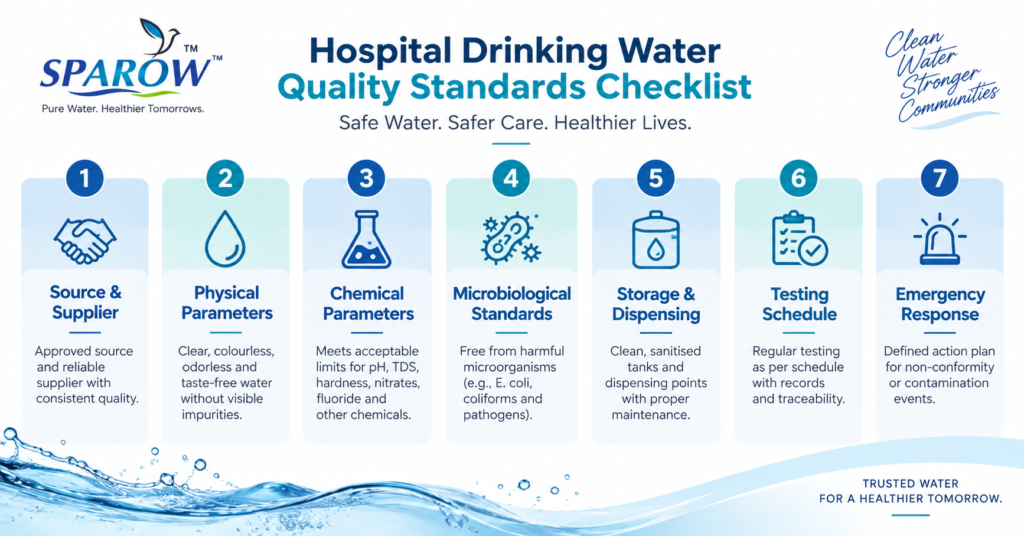
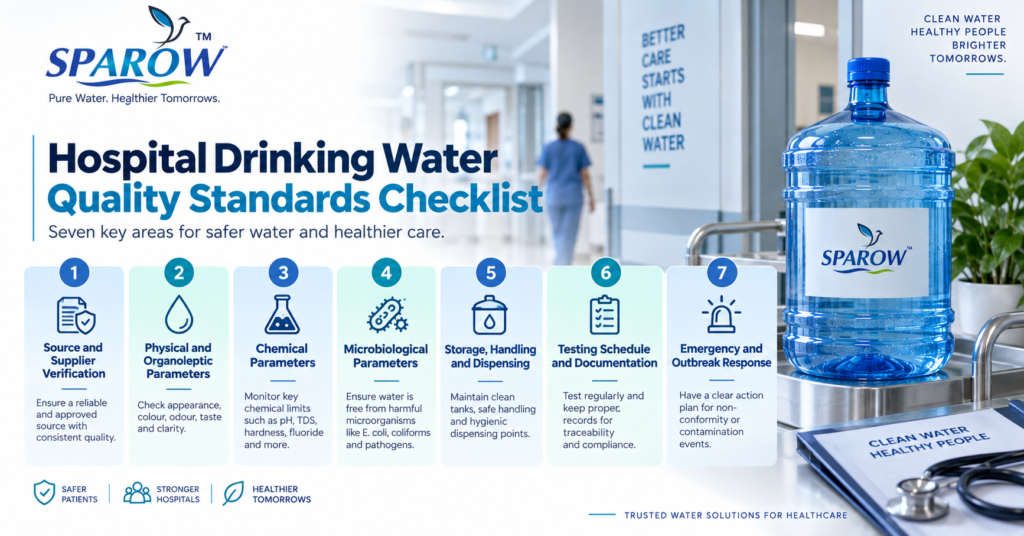
A complete hospital drinking water quality standards checklist covers seven domains:
- Source and supplier verification — where the water comes from and who is accountable
- Physical parameters — appearance, odour, taste, turbidity
- Chemical parameters — dissolved solids, hardness, heavy metals, disinfectant residue
- Microbiological parameters — coliforms, E. coli, total plate count, pathogens
- Storage and dispensing — containers, dispensers, contact surfaces, rotation
- Testing schedule — what gets tested, how often, by which laboratory
- Response protocol — what happens the moment a result fails
What it deliberately does not cover
This is important, and it is where a lot of hospital water policies go wrong.
Drinking water is only one of several water grades a hospital uses. Dialysis water, laboratory reagent water, CSSD steam feed water, and endoscope reprocessing rinse water each have their own, stricter specifications.
Passing a drinking water standard does not mean water is fit for dialysis. Treat them as separate systems with separate checklists and separate logbooks.
Why South Tamil Nadu Hospitals Need a Hospital Drinking Water Quality Standards Checklist
South Tamil Nadu presents a specific combination of conditions that makes water quality harder to manage than it looks.
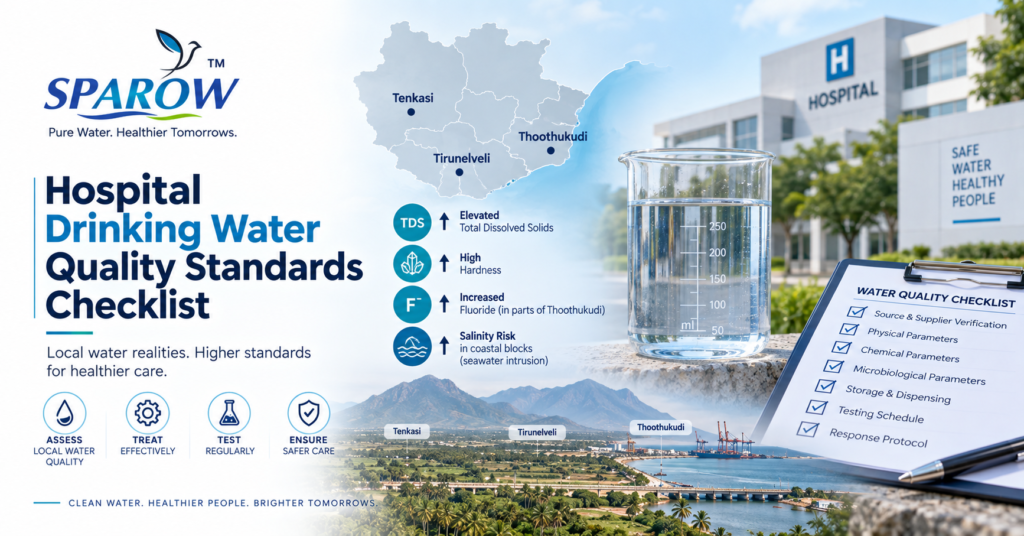
The groundwater picture in Tirunelveli, Thoothukudi and Tenkasi
Published groundwater studies from the Tirunelveli and Thoothukudi districts have repeatedly documented elevated total dissolved solids, hardness, and — in parts of Thoothukudi — fluoride concentrations in shallow aquifers. Coastal blocks carry an additional salinity risk from seawater intrusion.
Two practical consequences follow for hospitals:
- Borewell water in this region is a raw material, not a product. It needs treatment, and the treatment needs verification.
- Water quality shifts seasonally. Post-monsoon dilution and pre-monsoon concentration mean a single annual test tells you very little.
A hospital drinking water quality standards checklist forces you to test across the year rather than once, which is the only way to see that variation.
The summer supply problem
Between March and July, municipal supply in much of South Tamil Nadu becomes intermittent. Hospitals respond by buying whatever tanker or can water is available at short notice.
That emergency substitution is the single highest-risk moment in the annual water cycle. It is also the moment most hospitals skip verification entirely, because the ward needs water now.
Your checklist must have a documented emergency-sourcing clause. If it does not, the checklist will fail exactly when you need it most.
What poor water quality actually costs a hospital
The costs are rarely booked as “water”.
- Clinical: avoidable gastrointestinal infection in immunocompromised inpatients, extended length of stay, additional antibiotic exposure
- Regulatory: gaps in NABH evidence files, adverse observations during FSSAI inspection of the hospital kitchen
- Reputational: in a district town, one contamination rumour circulates faster than any marketing you will ever buy
- Operational: staff time lost to complaints, re-supply, and unplanned tank cleaning
The Rules That Actually Govern Hospital Drinking Water in India
Hospital administrators often assume water regulation is vague. It is not — it is layered, and each layer answers a different question.
FSSAI: the layer that governs your packaged water supplier
Packaged drinking water in India falls under the Food Safety and Standards Authority of India. Every manufacturer must hold a valid FSSAI licence, and the compliance regime tightened significantly from 1 January 2026, when FSSAI’s revised Scheme of Testing came into force.
Under that scheme, packaged drinking water manufacturers must carry out:
| Test category | Minimum frequency |
|---|---|
| Microbiological parameters | Monthly |
| Chemical and general parameters | Quarterly |
| Pesticide residues | Semi-annually |
| Comprehensive verification report | Six-monthly, as a licence condition |
All of this testing must be done at FSSAI-notified, NABL-accredited laboratories. Source water must also be tested before use.
Packaged drinking water has been placed in a higher-risk category, which means failed microbiological results can halt production until compliance is restored, and repeated non-compliance escalates to risk-based inspection.
What this means for your hospital: you are entitled to ask any supplier for their current FSSAI licence number and their most recent NABL test reports. A supplier who cannot produce both within a working day is not a supplier you should be putting in a patient ward.
NABH: the layer that governs your hospital
The National Accreditation Board for Hospitals and Healthcare Providers expects accredited facilities to demonstrate a documented, monitored approach to facility safety, including potable water.
Assessors are not usually looking for exotic parameters. They are looking for:
- A written water quality policy with a named owner
- Evidence of periodic testing at an accredited laboratory
- Records covering a full accreditation cycle, not just the last quarter
- Corrective action records showing what you did when a result failed
- Tank cleaning and disinfection logs
A hospital drinking water quality standards checklist is, in practice, the document that generates all five.
NABL: the layer that governs your test results
A test report is only as credible as the laboratory that issued it. NABL accreditation is the recognised mark of laboratory competence in India, and FSSAI’s testing scheme specifically requires notified NABL labs.
Ask for the lab’s accreditation certificate and confirm that the specific parameters you are testing fall inside its scope. Labs are accredited parameter by parameter, not blanket.
The specialised layer: dialysis and clinical water
Dialysis water sits outside the drinking water conversation. Renal units generally work to the ISO 23500 series, which superseded the older AAMI RD62 guidance.
Because different Indian units still reference different editions, the safest position for an administrator is this: confirm in writing which edition your nephrology team follows, and hold the unit to that document’s limits for total viable count and endotoxin. Do not assume drinking water compliance covers it. It does not.
The Complete Hospital Drinking Water Quality Standards Checklist
This is the operational core of the article. Print it, assign owners, and sign it.
Section 1 — Source and Supplier Verification
Start here, because every downstream control depends on it.
- ☐ Primary water source identified in writing (municipal, borewell, packaged supplier, or combination)
- ☐ Secondary and emergency sources identified in advance, with the same verification standard
- ☐ Supplier’s current FSSAI licence collected, verified, and diarised for expiry
- ☐ Supplier’s most recent NABL microbiological report on file (dated within the last month)
- ☐ Supplier’s most recent chemical analysis on file (dated within the last quarter)
- ☐ Manufacturing location known and, ideally, physically visited
- ☐ Delivery vehicle hygiene observed at least once per quarter
- ☐ Written supply agreement specifying quality parameters and remedies for failure
- ☐ Named contact at the supplier for quality escalations, available on phone
- ☐ Batch or lot traceability confirmed — you can trace any can or jar back to a production date
If you are starting this section from scratch, our hospital and healthcare water supply page lists the documents we provide as standard licence copy, current test reports, and batch traceability so you can file them straight against these ten lines.
Section 2 — Physical and Organoleptic Parameters
These are the checks your housekeeping supervisor can perform daily without instruments.
- ☐ Water is clear, with no visible suspended matter
- ☐ No unusual colour when viewed against a white background
- ☐ No detectable odour — chlorine, earthy, metallic, or plastic
- ☐ No off taste reported by staff or patients
- ☐ Turbidity checked periodically against your agreed specification
- ☐ Container internal surfaces free from biofilm, scaling, or algal growth
- ☐ Seal integrity intact on every packaged unit received
Section 3 — Chemical Parameters
Test these at the frequency agreed with your laboratory, and always after any change of source.
- ☐ pH within the specification stated in your water policy
- ☐ Total dissolved solids measured and trended over time
- ☐ Total hardness measured — relevant across much of South Tamil Nadu
- ☐ Chlorides measured, particularly for coastal facilities
- ☐ Fluoride measured, particularly in and around Thoothukudi district
- ☐ Nitrates measured
- ☐ Iron and manganese measured where borewell water is used
- ☐ Heavy metals — lead, arsenic, cadmium, mercury, chromium — screened periodically
- ☐ Residual disinfectant measured where chlorination is used
- ☐ Results trended, not just filed — a rising TDS line is a warning
Section 4 — Microbiological Parameters
This is the section that protects patients. Treat any failure here as a clinical event, not an administrative one.
- ☐ Total coliforms tested monthly at minimum
- ☐ E. coli / thermotolerant coliforms tested monthly
- ☐ Total plate count monitored and trended
- ☐ Faecal streptococci tested as part of the periodic panel
- ☐ Pseudomonas aeruginosa screened, especially for ICU and immunocompromised areas
- ☐ Sampling covers point of use, not only point of supply
- ☐ Sampling covers the furthest and least-used outlets, where stagnation occurs
- ☐ Post-corrective-action resampling performed and documented
- ☐ Any positive result triggers the response protocol within 24 hours
Section 5 — Storage, Handling and Dispensing
- ☐ All storage tanks cleaned and disinfected on a documented schedule
- ☐ Tank cleaning records signed, dated, and retained
- ☐ Tanks covered, vermin-proof, and fitted with intact lids
- ☐ Overhead and underground tanks inspected for cracks and ingress
- ☐ Packaged water stored away from direct sunlight, heat, and chemical stores
- ☐ Stock rotated on first-in-first-out, with visible date marking
- ☐ Dispenser taps and nozzles cleaned and disinfected on a written schedule
- ☐ Dispenser drip trays emptied and sanitised daily
- ☐ Staff trained not to touch the neck or mouth of jars during loading
- ☐ Returnable containers inspected on receipt and rejected if damaged or soiled
- ☐ No storage of returnable jars directly on the floor
Section 6 — Testing Schedule and Documentation
A hospital drinking water quality standards checklist is only defensible if it produces records.
- ☐ Written water quality policy exists and names an accountable owner
- ☐ Annual testing calendar published and circulated
- ☐ Laboratory selected, with NABL scope verified for your parameters
- ☐ Sampling procedure written down — who samples, from where, in what container
- ☐ All reports filed chronologically and retrievable within five minutes
- ☐ Non-conformance register maintained
- ☐ Corrective and preventive actions recorded against each non-conformance
- ☐ Records retained for at least one full accreditation cycle
- ☐ Annual management review of water quality data completed
Section 7 — Emergency and Outbreak Response
- ☐ Written protocol for suspected contamination, with escalation contacts
- ☐ Named decision-maker authorised to stop distribution immediately
- ☐ Pre-approved alternate supplier identified, with licence already verified
- ☐ Communication template ready for wards, kitchen, and administration
- ☐ Infection control team notified automatically on any microbiological failure
- ☐ Post-incident review conducted and documented
- ☐ Emergency sourcing clause in place for summer supply interruptions
Zone-by-Zone: Applying the Hospital Drinking Water Quality Standards Checklist by Department
Not every area of a hospital carries the same risk. Applying a uniform standard everywhere wastes money in low-risk zones and under-protects high-risk ones.
| Zone | Risk level | Priority controls | Suggested micro testing |
|---|---|---|---|
| ICU / CCU | Very high | Sealed packaged water only; Pseudomonas screening; dedicated dispensers | Monthly, plus on any suspicion |
| NICU / paediatric | Very high | Sealed units; strictest handling discipline; no shared jars | Monthly |
| Oncology / transplant | Very high | Sealed units; enhanced microbiological panel | Monthly |
| Dialysis unit | Separate specification | Governed by the renal unit’s own water standard, not this checklist | Per the unit’s protocol |
| General wards (IPD) | High | Verified supplier; dispenser hygiene; FIFO rotation | Monthly |
| Operation theatre complex | High | Potable water for staff only; process water handled separately | Monthly |
| Kitchen and diet section | High | FSSAI-aligned handling; food-contact water verified | Monthly |
| OPD and waiting areas | Moderate | High-volume dispensers; frequent cleaning; visible date marking | Quarterly |
| Staff areas and canteen | Moderate | Standard verified supply | Quarterly |
| Administrative blocks | Low | Standard verified supply | Half-yearly |
The dispenser blind spot
In most hospitals, the water is fine when it arrives and compromised at the point of use.
High-traffic OPD dispensers in a Tirunelveli or Madurai hospital can serve several hundred people a day. The nozzle is touched, the tray collects standing water, and the ambient temperature does the rest.
Add dispenser cleaning to the housekeeping checklist with a signature line. It costs nothing and removes one of the most common contamination routes in the building.
Bulk Water vs Cans vs In-House RO: What Should a Hospital Use?
There is no universally correct answer, but there is a correct way to decide.
| Factor | Bulk packaged supply | 20-litre returnable cans | In-house RO plant |
|---|---|---|---|
| Capital cost | None | None | High |
| Running cost per litre | Low to moderate | Moderate | Low, but excludes maintenance |
| Accountability for quality | Sits with a licensed manufacturer | Sits with a licensed manufacturer | Sits entirely with the hospital |
| Testing burden on hospital | Verification only | Verification only | Full testing responsibility |
| Consistency | High, if supplier is disciplined | High | Depends on membrane condition and servicing |
| Failure mode | Supply interruption | Container hygiene | Silent degradation of output quality |
| Best suited to | 100+ bed facilities with steady demand | Small and mid-size facilities, OPD-heavy | Facilities with technical staff and a maintenance budget |
The honest limitation of in-house RO
An in-house plant looks cheapest per litre and often is. The risk is that it degrades invisibly.
Membranes foul, pre-filters saturate, and post-treatment UV lamps lose intensity long before they stop glowing. Unless you are testing output monthly and logging maintenance rigorously, an in-house plant transfers the entire quality risk onto a hospital team that already has enough to do.
If you run one, your hospital drinking water quality standards checklist must include a plant maintenance section with membrane replacement dates, filter change logs, and UV lamp hours.
Where bulk supply wins
For a hospital consuming several thousand litres a day, a licensed bulk supplier moves the manufacturing risk off your balance sheet and onto a party whose FSSAI licence depends on getting it right — with monthly NABL testing they are already obliged to perform.
Your job reduces to verification, storage discipline, and point-of-use hygiene. That is a far more manageable scope for a facilities team.
Healthcare is also the one vertical where supply consistency matters as much as water quality. A ward cannot pause because a delivery slipped by a day, which is why our packaged drinking water supply for hospitals and healthcare facilities is planned around measured daily consumption in litres rather than standing orders. Volume, delivery frequency, and documentation are agreed upfront, so the checklist you build stays intact through the April-to-June peak.
How to Audit Your Packaged Drinking Water Supplier
Use these ten questions. Ask them on a phone call, then ask for the documents in writing.
- What is your current FSSAI licence number, and when does it expire? A licensed manufacturer answers this instantly.
- Which NABL-accredited laboratory do you use? Ask for the lab name and the accreditation certificate.
- Can I see your most recent microbiological test report? Under the current testing scheme this should be no more than a month old.
- Can I see your most recent chemical analysis? Should be no more than a quarter old.
- What is your source water, and how is it treated? You want a specific answer, not “RO purified”.
- How do you clean and sanitise returnable containers? Ask about the process, the frequency, and the rejection criteria.
- Can I visit the plant? A confident manufacturer says yes. Hesitation is information.
- What is your batch traceability system? You must be able to trace a specific jar back to a production date.
- What happens if a test fails after delivery? You want a written recall and replacement commitment.
- What is your delivery reliability during April to June? Summer supply is when suppliers are tested in South Tamil Nadu.
Reading the answers
Score each answer as documented, verbal, or evasive. Any supplier with more than two evasive answers should not be supplying a patient-care area, regardless of price.
Price differences between suppliers in this category are usually small. Reliability differences are not.
Storage and Handling: Where Most Hospitals Fail the Checklist
In practical audits, the failures cluster in the same places every time.
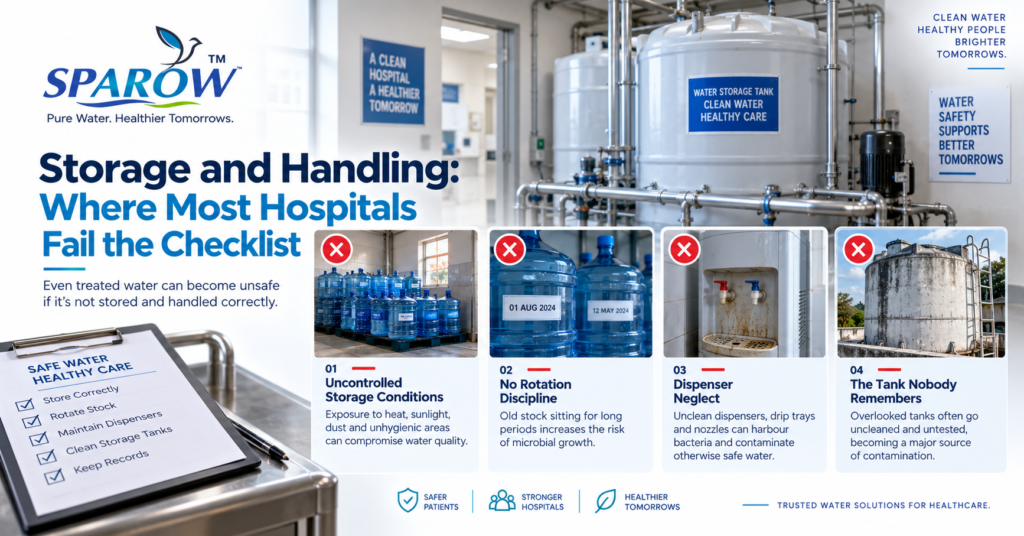
Failure one: uncontrolled storage conditions
Jars stacked outside a store room in direct afternoon sun, in a district where afternoon temperatures are punishing for several months of the year. Heat accelerates everything you do not want happening inside a sealed container.
Fix: designate a shaded, ventilated, dedicated water store. No chemicals, no cleaning agents, no floor-level stacking.
Failure two: no rotation discipline
Cans delivered on Monday get used on Monday because they are at the front. Cans from three weeks ago sit at the back.
Fix: mark receipt dates on arrival with a marker pen and enforce first-in-first-out physically, by stacking layout rather than by instruction.
Failure three: dispenser neglect
Everyone assumes the dispenser is somebody else’s job.
Fix: put a named owner and a signature sheet on every dispenser. Weekly cleaning, daily tray sanitisation, monthly deep clean.
Failure four: the tank nobody remembers
Many hospitals have an overhead tank that was last cleaned during a renovation nobody can date. If your tank cleaning record does not exist, assume the tank is a reservoir of biofilm and schedule a clean this month.
Testing Frequency and Documentation
Suggested testing calendar
| Parameter group | Suggested hospital frequency | Where to sample |
|---|---|---|
| Coliforms and E. coli | Monthly | Rotating point-of-use locations |
| Total plate count | Monthly | Rotating point-of-use locations |
| pH, TDS, hardness | Quarterly | Source and point of use |
| Chlorides, fluoride, nitrates | Quarterly | Source |
| Heavy metals | Half-yearly | Source |
| Pesticide residues | Half-yearly, via supplier reports | Supplier documentation |
| Full panel | Annually | Source and representative outlets |
| Post-tank-cleaning verification | Every cleaning event | Tank outlet |
| Post-incident resampling | Every incident | Affected points |
Treat this as a starting template. Increase frequency for high-risk zones, after any source change, and during periods of supply disruption.
The documentation set an auditor will ask for
Keep these seven items in one file, physical or digital:
- Written water quality policy with a named owner
- Current supplier FSSAI licence copies
- Supplier NABL test reports, chronologically filed
- Your own independent test reports
- Tank and dispenser cleaning logs with signatures
- Non-conformance and corrective action register
- Staff training records for water handling
If you can produce all seven within five minutes of being asked, your hospital drinking water quality standards checklist is working.
Common Mistakes Hospitals Make
Testing only at the source. Water can be perfect at the tank and contaminated at the ward dispenser. Sample where people actually drink.
Filing reports without reading them. A report that sits unopened proves you tested. It does not prove you were safe. Trend the numbers.
Assuming an FSSAI licence is a quality guarantee. The licence proves the manufacturer is authorised and subject to the testing scheme. Current test reports prove the water was fine this month.
Treating dialysis water as drinking water. They are different specifications with different consequences. Keep them in separate systems.
No named owner. A hospital drinking water quality standards checklist with no accountable person is a document, not a control.
Skipping verification during emergency purchase. The summer tanker you bought in a hurry is exactly the water most likely to cause a problem.
Cleaning tanks without recording it. If it is not signed and dated, it did not happen — at least not to an assessor.
Ignoring taste complaints. Staff and patients are your most sensitive early-warning system. A cluster of “the water tastes odd” reports deserves a sample, not a shrug.
How to Roll Out Your Hospital Drinking Water Quality Standards Checklist in 30 Days
A realistic implementation sequence for a mid-size facility.
Week 1 — Establish ownership and baseline
- Name one accountable owner, typically the facility or infection control manager.
- List every water source, storage point, and dispenser in the building.
- Collect current supplier FSSAI licences and test reports.
- Photograph existing storage conditions honestly, as your baseline.
Week 2 — Test and identify gaps
- Book a NABL-accredited laboratory and confirm parameter scope.
- Sample from source, storage, and at least four point-of-use locations.
- Run the seven-section checklist and mark every failing line.
- Rank the gaps by clinical risk, not by ease of fixing.
Week 3 — Fix and formalise
- Clean and disinfect all tanks; record the work.
- Set up dispenser cleaning schedules with named owners and signature sheets.
- Reorganise the water store for shade, ventilation, and FIFO stacking.
- Draft the written water quality policy — two pages is enough.
Week 4 — Embed and train
- Train housekeeping and ward staff on handling and reporting.
- Publish the annual testing calendar.
- Set up the non-conformance register.
- Diarise a quarterly review and an annual management review.
By day 30 you should have a signed policy, a baseline test set, a cleaning regime with owners, and a calendar. That is a working system.
Planning Your Daily Water Volume in Litres
Getting the volume right matters as much as getting the quality right, because shortages force emergency purchases and emergency purchases break the checklist.
How to calculate your requirement
Work it out from your own consumption rather than from a rule of thumb:
Step 1. Measure actual drinking water consumption for 14 consecutive days, in litres, counting every jar and bottle issued.
Step 2. Split the total across four groups — inpatients, attendants, outpatients, and staff.
Step 3. Divide each group’s total by the average headcount for that group to get litres per person per day.
Step 4. Multiply by your peak occupancy, not your average occupancy.
Step 5. Add a buffer of at least 20 percent for summer months and unplanned surges.
A worked illustration
This is an illustration of the method, not a benchmark figure — your own measurement replaces every number here.
A hospital measures 1,400 litres of drinking water consumed per day across 90 occupied beds, roughly 130 attendants, 240 outpatients, and 110 staff. Peak occupancy runs about 15 percent above average, and the facility adds a 20 percent summer buffer.
Its planning figure becomes approximately 1,400 × 1.15 × 1.20 = 1,932 litres per day, which it rounds to a 2,000-litre daily supply commitment.
That figure then drives the supply contract, the storage footprint, and the delivery schedule — and it is the number that stops your hospital from ever having to buy unverified water in a hurry.
Key Takeaways
- A hospital drinking water quality standards checklist covers seven domains: source and supplier, physical parameters, chemical parameters, microbiological parameters, storage and dispensing, testing schedule, and emergency response.
- Packaged drinking water suppliers in India are governed by FSSAI, with a stricter Scheme of Testing effective from 1 January 2026 requiring monthly microbiological testing at FSSAI-notified NABL-accredited laboratories.
- Ask every supplier for their FSSAI licence and their latest NABL reports. Verified paperwork within one working day is the minimum standard.
- Sample at the point of use, not only at the source. Most contamination happens downstream of delivery.
- Apply the checklist by zone — ICU, NICU and oncology need tighter control than administrative blocks.
- Dialysis water is a separate specification governed by the renal unit’s own standard. Never assume drinking water compliance covers it.
- South Tamil Nadu’s groundwater variability and summer supply gaps make a documented emergency-sourcing clause essential.
- Calculate your daily requirement in litres from measured consumption, then add a peak-occupancy and summer buffer.
Conclusion
Water is the one thing every single person in your hospital consumes, and it is usually the least governed input in the building.
The good news is that this is a solvable problem with an unusually good return. A hospital drinking water quality standards checklist costs almost nothing to implement, takes about 30 days to embed, and removes an entire category of clinical, regulatory, and reputational risk.
Start with ownership. Name one person. Then work through the seven sections, fix what fails, and put a testing calendar on the wall.
If your supply side is the weak link — inconsistent deliveries, missing test reports, a supplier who cannot show you a current FSSAI licence — fix that first. Everything else in the checklist depends on it.
FAQs
1. What is a hospital drinking water quality standards checklist?
It is a written, auditable list covering everything that affects potable water safety in a healthcare facility: source and supplier verification, physical and chemical parameters, microbiological limits, storage and dispensing hygiene, testing frequency, documentation, and emergency response. Unlike a single test report, which reflects one sample on one day, the checklist confirms the whole system is under control. Hospitals use it to generate the evidence accreditation assessors ask for and to protect vulnerable patients from waterborne infection.
2. How often should a hospital test its drinking water?
Microbiological parameters — coliforms, E. coli, and total plate count — should be tested at least monthly, sampled from rotating point-of-use locations rather than only from the source. Chemical parameters such as pH, TDS, hardness, chlorides and fluoride are typically tested quarterly, with heavy metals half-yearly and a full panel annually. Increase frequency after any source change, after tank cleaning, during supply disruption, and immediately following any failed result or suspected contamination.
3. Does an FSSAI licence guarantee the water is safe?
No. An FSSAI licence confirms the manufacturer is legally authorised and subject to the mandatory testing scheme. It does not confirm the water in the jar delivered to your ward this week was compliant. Always ask for current test reports alongside the licence — under the scheme effective from 1 January 2026, microbiological reports should be no more than a month old and chemical reports no more than a quarter old, from an FSSAI-notified NABL-accredited laboratory.
4. What water parameters matter most in a hospital?
Microbiological parameters matter most because they cause immediate clinical harm — total coliforms, E. coli, total plate count, and Pseudomonas aeruginosa for immunocompromised areas. Chemical parameters matter for long-term safety and palatability: pH, total dissolved solids, hardness, chlorides, fluoride, nitrates, and heavy metals. In South Tamil Nadu, hardness, chlorides and fluoride deserve particular attention given documented groundwater variability across Tirunelveli and Thoothukudi districts.
5. Can I use the same hospital drinking water quality standards checklist for dialysis water?
No, and this is a critical distinction. Dialysis water is governed by a separate, far stricter specification — most renal units work to the ISO 23500 series, which replaced older AAMI guidance. The limits for total viable count and endotoxin are dramatically tighter than drinking water limits because the water contacts blood across a membrane. Confirm in writing which standard edition your nephrology team follows and maintain a separate logbook and testing schedule for the renal unit.
6. Should our hospital install its own RO plant or buy packaged water?
It depends on scale and technical capacity. An in-house plant offers a low cost per litre but transfers the entire quality risk to your team, requires monthly output testing, and degrades invisibly as membranes foul and UV lamps weaken. A licensed bulk supplier moves manufacturing risk to a party whose FSSAI licence depends on monthly testing they are already obliged to perform. Facilities without dedicated technical staff and a maintenance budget generally get better outcomes from verified external supply.
7. Who should own water quality in a hospital?
One named person, usually the facility manager or infection control officer, with clear authority to stop distribution immediately if contamination is suspected. Shared ownership between purchase, housekeeping and infection control is the most common reason water quality systems fail — everyone assumes someone else is checking. The accountable owner should sign the testing calendar, review results, maintain the non-conformance register, and present water quality data at the annual management review.
8. What records do NABH assessors typically ask for regarding water?
Assessors generally look for a written water quality policy with a named owner, evidence of periodic testing at an accredited laboratory, records covering a full accreditation cycle rather than just recent months, tank and dispenser cleaning logs with signatures, and corrective action records showing what was done when a result failed. A functioning hospital drinking water quality standards checklist naturally generates all of these as a by-product of routine operation.
9. How much drinking water does a hospital need per day in litres?
Calculate it from measured consumption rather than a generic ratio. Record actual litres issued daily for 14 consecutive days, split the total across inpatients, attendants, outpatients and staff, divide by the average headcount for each group, then multiply by peak occupancy and add a buffer of at least 20 percent for summer months. That final figure should drive your supply contract and storage capacity so you never have to buy unverified water in an emergency.
10. What should we do immediately if a water test fails?
Treat it as a clinical event. Stop distribution from the affected point, notify infection control the same day, switch to a pre-verified alternate source, and record the failure in your non-conformance register. Identify the likely cause — tank contamination, dispenser hygiene, or supply-side failure — correct it, then resample and confirm compliance before resuming. Document every step. Your hospital drinking water quality standards checklist should already name the person authorised to make the stop-distribution call.
Fix the supply side first
SPAROW supplies FSSAI-licensed packaged drinking water in bulk to hospitals, clinics, and healthcare facilities across Tirunelveli and South Tamil Nadu.
If you are building or tightening your hospital drinking water quality standards checklist, the supply side is the fastest thing to fix. We provide current FSSAI licence documentation, laboratory test reports on request, batch traceability, and delivery schedules planned around your measured daily requirement in litres — including through the April-to-June peak, when supply reliability matters most.
📞 Request a supply assessment. Tell us your bed count, occupancy, and current daily consumption, and we will help you calculate a realistic daily volume and a delivery schedule that keeps your wards supplied without emergency purchases.
📄 Or ask for our supplier verification document pack — licence, test reports, and traceability details, ready to file directly against Section 1 of your checklist.
Sources:
- FSSAI Scheme of Testing for Packaged Drinking Water & Mineral Water
- FSSAI updates the revised scheme for testing packaged drinking water — Food Compliance International
- Dialysis Water Quality: AAMI Standards, RO System Design, and Microbiological Monitoring
- ISO 23500 Series: Ensuring Quality of Fluids for Hemodialysis — AAMI
- Geochemical evaluation of fluoride contamination of groundwater in the Thoothukudi District of Tamil Nadu
- Appraisal of groundwater quality for drinking and irrigation suitability, Tirunelveli — PubMed
About the author
Brawin Rajadurai is the founder of RD Reigrow Private Limited, the company behind SPAROW packaged drinking water, supplying hospitals, institutions and businesses across Tirunelveli and South Tamil Nadu. He works directly with facility managers on supply planning, FSSAI documentation, and water quality verification. He writes about building operations-heavy businesses in Tamil Nadu at brawinrajadurai.com.