

Quick Answer: To choose a packaged drinking water supplier for hospitals, verify their FSSAI licence on the FoSCoS portal, demand batch-wise NABL lab reports, audit the plant in person, confirm daily capacity in litres, check delivery SLAs and storage practices, compare cost per litre, and run a 30-day supply trial before signing.
Table of Contents
Every hospital buys drinking water. Very few hospitals actually vet the people who supply it.
That gap is where the risk sits. A ward dispenser refilled from a poorly washed jar reaches immunocompromised patients, post-operative cases, dialysis patients, and newborns — people whose bodies have no margin for a bacterial load a healthy adult would shrug off. Knowing how to choose a packaged drinking water supplier for hospitals is therefore not a purchasing exercise. It is an infection control decision that happens to have a price tag attached.
Most procurement teams still shortlist on rate per jar and delivery frequency. Then a licence lapses, a batch fails, an accreditation auditor asks for six months of test reports, and nobody can produce them.
This guide fixes that. You will get a ten-step evaluation framework, a scoring sheet you can use in a tender meeting, the exact documents to ask for, the red flags that should end a conversation, and a South Tamil Nadu view of what actually goes wrong on the ground.
Why Hospital Water Buying Is Not Like Any Other Purchase
A hotel that receives a bad batch of water gets complaints. A hospital that receives a bad batch gets an outbreak investigation.
Three things make healthcare procurement structurally different.
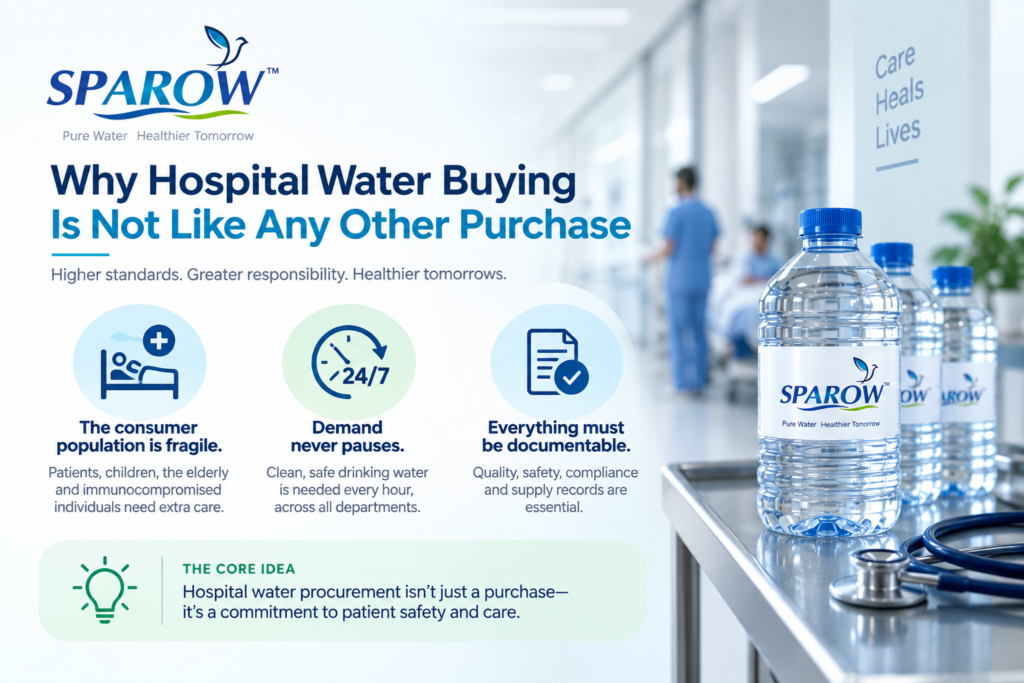
The consumer population is fragile. Oncology wards, ICUs, transplant units, neonatal care and dialysis floors concentrate patients with weakened immunity. Organisms that cause a mild upset in the general population can cause serious illness here.
Demand never pauses. Wards, duty rooms, OT staff areas, attendant lounges, OPD waiting halls and canteens all draw water simultaneously, twenty-four hours a day. A single missed delivery is not an inconvenience — it forces staff to improvise, and improvisation is where hygiene breaks.
Everything must be documentable. Accreditation bodies and food safety inspectors do not accept verbal assurance. They ask for the supplier’s licence, the test reports, the batch records and the complaint log. If your vendor cannot produce them, the non-conformity lands on your file, not theirs.
The core idea: you are not buying water. You are buying a documented, repeatable, inspectable process that produces safe water — every single batch, every single day.
Why Knowing How to Choose a Packaged Drinking Water Supplier for Hospitals Matters More Than Price
Here is the uncomfortable arithmetic.
Drinking water is usually a rounding error in a hospital’s total procurement spend. But it is consumed by literally every person who enters the building patients, attendants, doctors, nurses, housekeeping, visitors.
So the item with the smallest budget line has the largest exposure surface in the entire facility.
Squeezing another few paise per litre out of a vendor saves a modest annual sum. A single traced contamination event costs far more in investigation time, patient trust, regulatory scrutiny and reputation. The maths is not close.
This is why understanding how to choose a packaged drinking water supplier for hospitals properly — with a structured process rather than a rate comparison — is one of the highest-leverage decisions a procurement head makes all year.
What “Packaged Drinking Water” Legally Means in India Today
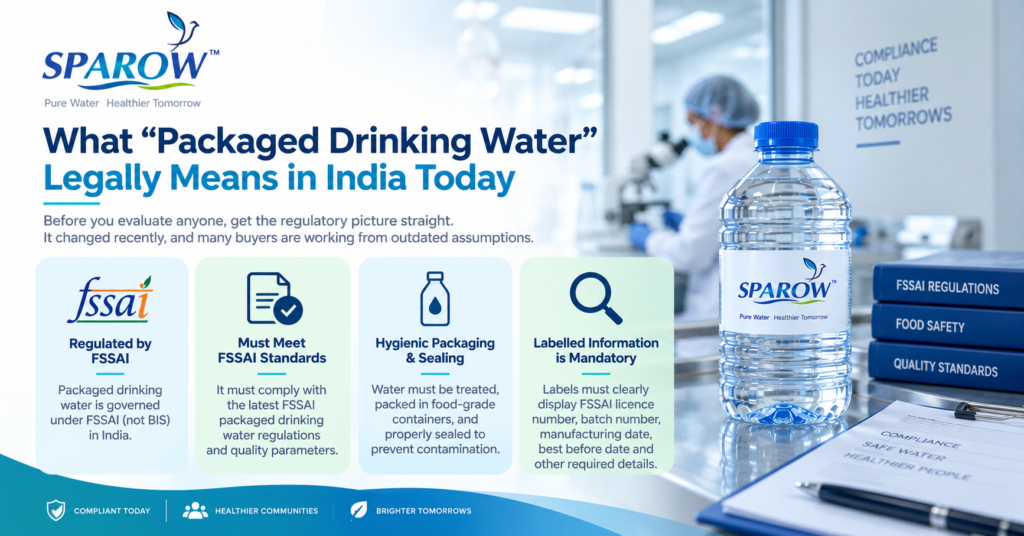
Before you evaluate anyone, get the regulatory picture straight. It changed recently, and many buyers are working from outdated assumptions.
The FSSAI licence is the licence that matters
In an order dated 17 October 2024, FSSAI made a Food Safety Licence or Registration through the FSSAI portal the mandatory route for packaged drinking water manufacturers. Manufacturers must submit every batch of bottled water for testing in an FSSAI-approved laboratory, and labels must carry the FSSAI logo along with the licence number, brand name, manufacturer address, lot or batch number, packaging date and best-before date.
Translation for a buyer: if the label does not show an FSSAI number, the conversation is over.
Packaged water is now a high-risk food category
This is the part most hospital buyers have not caught up with.
By an order dated 29 November 2024, FSSAI added packaged drinking water and mineral water to its high-risk food category under the Risk Based Inspection Scheduling Policy. That classification carries three concrete obligations for manufacturers:
- Mandatory inspection before a licence or registration is granted.
- At least one inspection every year for businesses producing packaged drinking water.
- An annual third-party audit by an FSSAI-recognised food safety auditing agency, for all centrally licensed manufacturers in the high-risk category.
That gives you a powerful, simple screening question that most competitors will not ask: “Show me your most recent third-party audit report.”
A serious manufacturer has one. A borderline operator will change the subject.
What this means for your shortlist
| Document | Why you need it | Acceptable proof |
|---|---|---|
| FSSAI licence | Legal right to manufacture | Licence copy + live check on the FoSCoS portal |
| Batch test reports | Proof of ongoing quality | Reports from an FSSAI-approved / NABL lab, last 6 months |
| Third-party audit report | Independent verification | Latest annual audit by an FSSAI-recognised agency |
| Label artwork | Traceability compliance | Licence number, batch code, packing and expiry dates visible |
How to Choose a Packaged Drinking Water Supplier for Hospitals: The 10-Step Framework
Work through these in order. Each step filters out a layer of risk, and the early steps are cheap to run — so you disqualify weak vendors before you spend time on site visits.

Use this framework whenever you are deciding how to choose a packaged drinking water supplier for hospitals, whether you are a 30-bed nursing home or a 500-bed multi-speciality unit.
Step 1: Verify the FSSAI Licence First
Do not accept a photocopy. Do not accept a WhatsApp forward of a certificate image.
What to do:
- Ask for the licence number in writing.
- Check it yourself on the FSSAI FoSCoS portal.
- Confirm three things match: the legal entity name, the manufacturing address, and the product category (packaged drinking water must be listed).
- Check the validity date. Expired licences are common and rarely volunteered.
A trap worth knowing: some suppliers are traders, not manufacturers. They hold a distribution licence and buy water from a third plant you have never inspected. If your vendor is a trader, you must vet the actual manufacturing plant too — otherwise you are auditing an empty warehouse.
Ask directly: “Do you manufacture this yourself, and is this licence for the plant or for the trading company?”
Step 2: Demand Batch-Wise Lab Reports
One test report proves one good day. Hospitals need proof of consistency.
Ask for the last six months of reports, and check that testing was done at an FSSAI-approved or NABL-accredited laboratory. An in-house plant lab is useful for daily monitoring but does not replace external testing.
Parameters to look for:
Microbiological (zero tolerance)
- E. coli
- Coliform bacteria
- Pseudomonas aeruginosa
- Salmonella and Shigella
- Faecal streptococci
Physical and chemical
- pH
- Total dissolved solids
- Turbidity
- Residual free chlorine
- Total hardness
- Nitrate and fluoride
- Heavy metals such as lead and arsenic
How to read them like a professional:
- Do the report dates form a regular pattern, or are they clustered around the month the vendor was applying for something?
- Does the batch number on the report actually correspond to a batch code you can find on a bottle?
- Are any results simply blank or marked “not tested”?
A vendor who sends you a neat, chronological file within a day is telling you something important about how they run the plant. A vendor who takes two weeks and sends one report from last year is also telling you something.
Step 3: Audit the Plant in Person
How to choose a packaged drinking water supplier for hospitals during a plant visit
Go unannounced if the relationship allows it. Announced visits show you the plant they can prepare; unannounced visits show you the plant they run.
Walk the process from water in to pallet out.
Raw water source. Borewell, municipal supply or surface water — ask which, and ask to see the source water test reports. Source quality drives everything downstream, and in parts of Tamil Nadu source hardness and salinity are genuinely challenging.
Treatment train. A credible plant will show you a defined sequence: sand or multimedia filtration, activated carbon, softening or antiscalant dosing, reverse osmosis, micron cartridge filtration, and a final disinfection stage using ozone, ultraviolet treatment or both. Ask them to explain why each stage is there. Operators who understand their own plant answer in seconds.
Filling room. This is the single most revealing room in the building. Look for:
- Enclosed, automated rinse-fill-seal operation rather than manual filling
- Controlled air quality and positive pressure in the filling area
- Staff in clean uniforms, head covers, and footwear discipline at the entry
- No open containers, no exposed caps, no bare-hand contact with bottle necks
Jar washing line. If you plan to buy 20 litre returnable jars, this is where your risk actually lives. Ask to see the jar washing and sanitisation line, the rejection criteria for scuffed or old jars, and how they handle jars returned from unknown premises.
Records. Ask for batch production records, cleaning logs, pest control records and the training certificate of their food safety supervisor. Records that are all filled in with the same pen on the same day are not records.
Effluent handling. Reverse osmosis plants generate reject water. A plant with no plan for it usually has no plan for other things either.
Step 4: Match Pack Sizes to Hospital Zones
Hospitals do not have one water requirement. They have five or six, and using the wrong format in the wrong zone creates both waste and risk.
| Zone | Recommended format | Reason |
|---|---|---|
| ICU, oncology, transplant, neonatal | Sealed 0.25 or 0.5 litre bottles | Single-serve, tamper-evident, no shared vessel |
| Inpatient rooms and wards | Sealed 1 litre bottles | Patient-specific, easy to track consumption |
| Attendant and visitor areas | 1 or 2 litre bottles | Cost-efficient per litre, still sealed |
| Corridor and lobby dispensers | 20 litre returnable jars | Lowest cost per litre for high footfall |
| Staff duty rooms and pantries | 5 or 20 litre jars | Controlled access, predictable draw |
| Canteen and kitchen | 20 litre jars | Bulk consumption |
The rule that matters: in high-risk clinical zones, use sealed single-serve packs. Dispensers involve shared touchpoints, jar changeovers by non-clinical staff, and standing water — all acceptable in a corridor, all avoidable at a bedside.
Estimating your requirement. Rather than relying on any generic industry figure, measure your own. For one week, record the total litres consumed per zone per day. Multiply by your peak occupancy factor. That number — your own number — is what should go into the tender. Vendors quote better and supply better against real litre figures than against guesses.
Step 5: Test Supply Reliability, Not Promises
Every supplier says they deliver on time. Very few will put a number against it.
Ask these seven questions, and write down the answers:
- What is your plant’s rated capacity in litres per day, and what percentage of it is currently committed?
- How many delivery vehicles do you operate, and how many are dedicated to institutional accounts?
- How far is your plant from our hospital in kilometres and in realistic travel time?
- What is your standard order-to-delivery lead time?
- What happens if we need an emergency top-up at 10 pm on a Sunday?
- What is your contingency if your plant goes down for two days?
- What fill rate will you commit to contractually?
That last one is the real test. Fill rate is the percentage of ordered quantity delivered on the promised date. A supplier confident in their operation will commit to a high number in writing. A supplier who deflects has told you what their actual performance looks like.
Capacity headroom matters more than capacity. A plant running at near-full commitment has nothing left for your festival-week surge or your monsoon disruption. Ask what percentage of capacity is uncommitted.
Step 6: Inspect Storage and Handling
Half of the water quality problems in hospitals are created after delivery — in your own store room.
Good suppliers will help you fix this. Great suppliers will train your team on it.
What correct storage looks like:
- Stacked on pallets, never directly on the floor
- Out of direct sunlight and away from heat sources
- Well away from disinfectants, phenyl, detergents and chemical stores — PET packaging can pick up strong ambient odours
- Stock rotated first-expired-first-out, with the batch date visible without unstacking
- Clean, dry, ventilated area with no drain openings underneath
What to check on the delivery vehicle:
- Is the load covered and protected from sun and rain?
- Are jars and bottles transported with anything else — chemicals, food, cleaning material?
- Are damaged or bulging units removed at the point of delivery rather than argued about later?
For returnable 20 litre jars specifically, agree in writing on jar hygiene: how often jars are replaced, what the rejection criteria are for scratched or discoloured jars, and whether caps are tamper-evident. Ask your supplier to take back and destroy jars past their service life rather than recirculating them.
Step 7: Compare Cost Per Litre, Not Per Unit
This is where most tenders go wrong. A quote of “₹X per jar” and “₹Y per bottle” cannot be compared to anything.
Convert every quote to landed cost per litre:
Landed cost per litre  =  (Unit price + delivery charge share + GST)
                          ÷ litres per unit
Then build the comparison properly. Copy this table into your evaluation sheet and fill it from actual quotes:
| Cost element | Vendor A | Vendor B | Vendor C |
|---|---|---|---|
| Unit price (per pack) | |||
| Litres per pack | |||
| Base cost per litre | |||
| Delivery / freight charge | |||
| Jar security deposit | |||
| Jar loss / damage charge | |||
| Dispenser rental (if any) | |||
| GST | |||
| Landed cost per litre | |||
| Minimum order quantity | |||
| Payment terms | |||
| Price escalation clause |
Hidden costs to hunt for:
- Jar deposits that are never refunded in practice
- Dispenser rentals bundled invisibly into the water rate
- Delivery charges applied per trip, which punish you for small emergency orders
- Escalation clauses with no ceiling
A useful negotiating truth: the cheapest landed cost per litre is rarely the cheapest supplier once you account for stockouts, rejected batches and staff time spent chasing deliveries. Score price at roughly a quarter of your total evaluation weight, not all of it.
Step 8: Check Traceability and Recall Readiness
Ask one question: “If we report a problem with a specific jar tomorrow, how quickly can you tell us which batch it came from, which shift produced it, and where else that batch went?”
The answer separates professional manufacturers from everyone else.
What good traceability looks like:
- A batch code printed on every single unit, legibly, that survives handling
- Production records that link the batch to a date, a shift, a line and a raw water test
- Retained samples from each batch, held until expiry
- A documented recall procedure with named responsibilities
- Evidence of a mock recall drill — a practice run where they traced a batch end to end
Also check their complaint handling. Ask what their response time commitment is for a quality complaint from an institutional customer, and what the escalation path is. Then ask for a reference from another hospital or institutional client and actually call them.
Step 9: Weigh Regional Presence and Distance
Distance from plant to hospital is not a soft factor. It determines whether an emergency replenishment takes ninety minutes or half a day.
What to evaluate:
- Plant distance in real travel time, not kilometres on a map
- Local depot or stock point near your city, which shortens emergency response dramatically
- Route familiarity — a supplier who already services your area has drivers who know the gate, the loading bay and the security process
- Monsoon resilience — coastal and delta routes in South Tamil Nadu can be disrupted for days; ask what happened during the last major disruption
A regional supplier with a nearby plant frequently outperforms a large national brand routing stock from several hundred kilometres away, simply because response time compounds. When you are working out how to choose a packaged drinking water supplier for hospitals, geography deserves real weight in the scorecard — not a footnote.
Step 10: Run a 30-Day Trial Before You Sign
Never move from tender to annual contract in one step. Run a paid pilot.
Structure the trial like this:
| Week | What you measure |
|---|---|
| 1 | Delivery punctuality, packaging condition on arrival, documentation completeness |
| 2 | Send one unit to an independent NABL lab for testing — at your cost, without telling the vendor |
| 3 | Raise a deliberate small complaint and time the response |
| 4 | Place one urgent unscheduled order and see what happens |
Record every deviation. At the end of thirty days you will know more about the supplier than any tender document could have told you.
Then negotiate the annual contract from a position of evidence.
Supplier Evaluation Scorecard
Use this in your tender committee meeting. Score each vendor 1–5, multiply by the weight, and total.
| Criterion | Weight | Score (1–5) | Weighted |
|---|---|---|---|
| Valid FSSAI licence, verified on portal | 20% | ||
| Six months of batch test reports available | 15% | ||
| Plant audit outcome | 15% | ||
| Third-party audit report available | 10% | ||
| Supply reliability and committed fill rate | 10% | ||
| Traceability and recall readiness | 10% | ||
| Landed cost per litre | 10% | ||
| Distance and emergency response capability | 5% | ||
| Pack format range across hospital zones | 5% | ||
| Total | 100% |
Decision rule: any vendor scoring 2 or below on the first two criteria is disqualified outright, regardless of total score. Those two are gates, not points.
Red Flags That Should End the Conversation
Walk away if you see any of these.
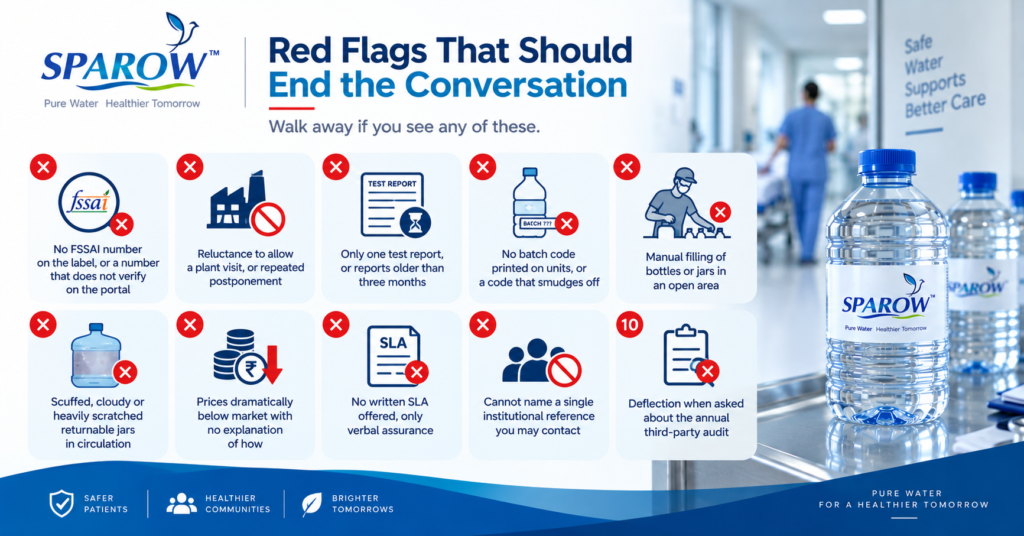
- No FSSAI number on the label, or a number that does not verify on the portal
- Reluctance to allow a plant visit, or repeated postponement
- Only one test report, or reports older than three months
- No batch code printed on units, or a code that smudges off
- Manual filling of bottles or jars in an open area
- Scuffed, cloudy or heavily scratched returnable jars in circulation
- Prices dramatically below market with no explanation of how
- No written SLA offered, only verbal assurance
- Cannot name a single institutional reference you may contact
- Deflection when asked about the annual third-party audit
Any one of these is a serious signal. Two or more, and you are looking at an operation that will eventually cause you a problem.
Common Mistakes When Learning How to Choose a Packaged Drinking Water Supplier for Hospitals
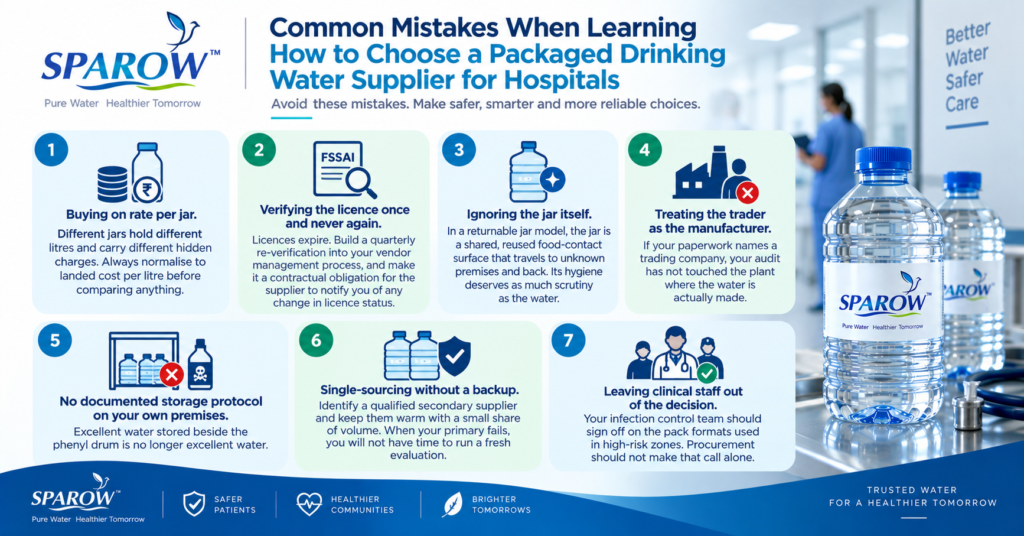
Mistake 1: Buying on rate per jar. Different jars hold different litres and carry different hidden charges. Always normalise to landed cost per litre before comparing anything.
Mistake 2: Verifying the licence once and never again. Licences expire. Build a quarterly re-verification into your vendor management process, and make it a contractual obligation for the supplier to notify you of any change in licence status.
Mistake 3: Ignoring the jar itself. In a returnable jar model, the jar is a shared, reused food-contact surface that travels to unknown premises and back. Its hygiene deserves as much scrutiny as the water.
Mistake 4: Treating the trader as the manufacturer. If your paperwork names a trading company, your audit has not touched the plant where the water is actually made.
Mistake 5: No documented storage protocol on your own premises. Excellent water stored beside the phenyl drum is no longer excellent water.
Mistake 6: Single-sourcing without a backup. Identify a qualified secondary supplier and keep them warm with a small share of volume. When your primary fails, you will not have time to run a fresh evaluation.
Mistake 7: Leaving clinical staff out of the decision. Your infection control team should sign off on the pack formats used in high-risk zones. Procurement should not make that call alone.
Your RFQ Checklist (Copy This Into Your Tender)
Ask every bidder to submit:
- FSSAI licence copy with number, validity and product category
- Confirmation of whether they are the manufacturer or a trader, with plant address
- Batch-wise laboratory test reports for the preceding six months
- Most recent third-party food safety audit report
- Plant capacity in litres per day and current committed percentage
- List of available pack formats with litres per pack
- Landed price per litre for each format, all charges inclusive
- Committed delivery schedule and fill rate percentage
- Emergency order response time commitment
- Jar replacement policy and rejection criteria, if supplying returnable jars
- Batch coding and traceability procedure
- Documented recall procedure with evidence of a mock recall
- Complaint response time commitment and escalation matrix
- Two institutional references with contact details
- Copy of product label artwork
Suppliers who can assemble this in a week are the suppliers who can run a hospital account.
Contract Clauses Every Hospital Should Insist On
Once you have selected a vendor, protect the relationship with paper.
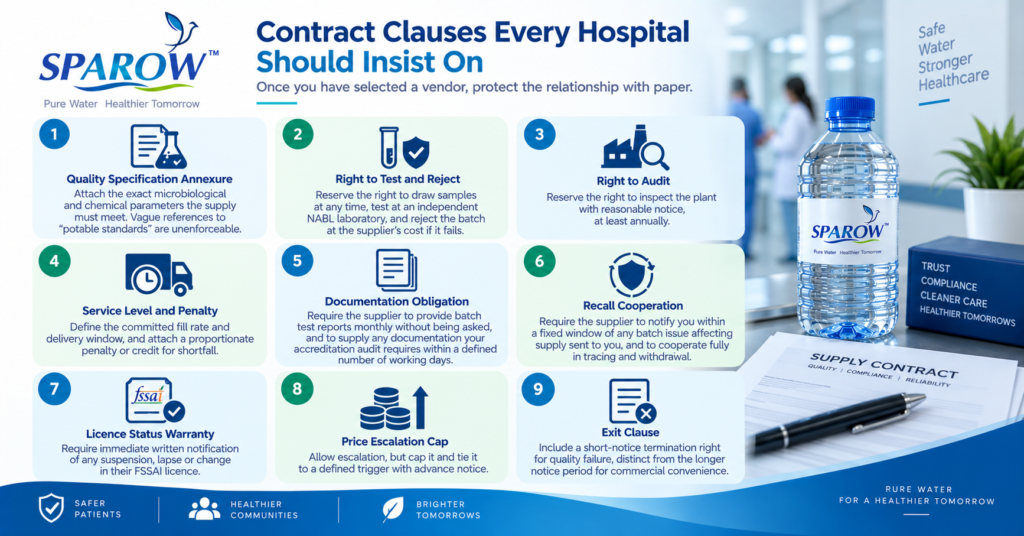
Quality specification annexure. Attach the exact microbiological and chemical parameters the supply must meet. Vague references to “potable standards” are unenforceable.
Right to test and reject. Reserve the right to draw samples at any time, test at an independent NABL laboratory, and reject the batch at the supplier’s cost if it fails.
Right to audit. Reserve the right to inspect the plant with reasonable notice, at least annually.
Service level and penalty. Define the committed fill rate and delivery window, and attach a proportionate penalty or credit for shortfall.
Documentation obligation. Require the supplier to provide batch test reports monthly without being asked, and to supply any documentation your accreditation audit requires within a defined number of working days.
Recall cooperation. Require the supplier to notify you within a fixed window of any batch issue affecting supply sent to you, and to cooperate fully in tracing and withdrawal.
Licence status warranty. Require immediate written notification of any suspension, lapse or change in their FSSAI licence.
Price escalation cap. Allow escalation, but cap it and tie it to a defined trigger with advance notice.
Exit clause. Include a short-notice termination right for quality failure, distinct from the longer notice period for commercial convenience.
How to Choose a Packaged Drinking Water Supplier for Hospitals in South Tamil Nadu
The framework above is universal. Applying it in South Tamil Nadu adds a few regional realities worth planning around.
Source water is genuinely variable. Groundwater hardness and dissolved solids differ significantly between inland districts and coastal belts. Near Thoothukudi and Ramanathapuram, salinity intrusion is a known challenge. This makes the source water test report far more informative here than it would be elsewhere — ask for it specifically, and ask how the treatment train is configured to handle that particular source.
Distance and terrain shape response time. Hospitals in Tirunelveli, Tenkasi, Madurai, Virudhunagar, Dindigul, Sivagangai, Theni, Nagercoil and Thoothukudi are spread across long routes. A supplier headquartered elsewhere but running a genuine regional distribution network will serve you better than one quoting an attractive rate from far away with no local stock point.
Monsoon and seasonal demand both spike. The northeast monsoon can disrupt routes, and temple festival seasons and summer months push consumption up sharply. Ask any prospective packaged drinking water supplier for hospitals how they handled the last major seasonal surge and the last weather disruption — specifically, what their fill rate was during those weeks.
Local presence compounds. A supplier with regional depots, drivers familiar with your hospital’s gate and loading bay, and a plant within a few hours can turn an emergency into a phone call. That operational closeness is difficult to quantify in a tender but shows up immediately in daily practice.
A note for suppliers reading this: if you are on the other side of this table a water brand trying to win institutional accounts this checklist doubles as a specification for what your business must be able to prove. Building the documentation, the audit trail and the response capability before you pitch is the most underrated customer acquisition strategy in the category. Hospitals do not buy from the cheapest vendor. They buy from the vendor who makes their audit easy.
How do I choose a packaged drinking water supplier for hospitals if I have never done it before?
Start with the two gates: verify the FSSAI licence on the FoSCoS portal, and ask for six months of batch test reports from an approved laboratory. Any supplier who clears both is worth a plant visit. After the visit, compare landed cost per litre, confirm delivery capability with a committed fill rate, and run a thirty-day paid trial before signing anything longer. That sequence removes most of the risk without needing prior experience.
Is an FSSAI licence mandatory for packaged drinking water suppliers?
Yes. Under the FSSAI order dated 17 October 2024, packaged drinking water manufacturers must obtain a Food Safety Licence or Registration through the FSSAI portal, and every batch must be tested at an FSSAI-approved laboratory. Labels must display the FSSAI logo and licence number alongside the batch code, packing date and best-before date. A product without a verifiable FSSAI number should never enter a hospital.
What does the “high-risk food category” classification mean for my supplier?
By an FSSAI order dated 29 November 2024, packaged drinking water and mineral water were added to the high-risk food category. Manufacturers must be inspected before receiving a licence, must undergo at least one inspection every year, and centrally licensed manufacturers must complete an annual third-party audit by an FSSAI-recognised auditing agency. Asking for that audit report is a fast, high-signal way to separate serious plants from casual operators.
Should hospitals use 20 litre jars or sealed bottles?
Use both, zone by zone. Sealed single-serve bottles of 0.25 to 1 litre belong in ICUs, oncology, transplant, neonatal and inpatient rooms, because they eliminate shared vessels and provide tamper evidence. Returnable 20 litre jars are appropriate for corridors, canteens, staff areas and administration, where cost per litre matters and the population is healthy. Never place jar dispensers in high-risk clinical zones.
How often should hospital drinking water be tested?
Your supplier should be testing every batch at an approved laboratory and sharing those reports with you monthly. Separately, the hospital should conduct its own independent verification testing at a NABL-accredited laboratory at least quarterly, drawing samples without informing the vendor in advance. Independent testing is what turns supplier assurance into verified fact, and it is inexpensive relative to the risk it covers.
What is a reasonable fill rate to demand in a contract?
Ask the supplier to state a number and commit to it contractually, with a proportionate credit or penalty for shortfall. The specific figure matters less than the fact that it is written down and measured. Track actual performance monthly against the commitment. A supplier who refuses to commit to any number in writing is telling you their reliability is not something they can control.
How do I compare quotes when suppliers use different pack sizes?
Convert everything to landed cost per litre. Take the unit price, add the delivery charge share, jar deposit amortisation, dispenser rental and GST, then divide by the litres in that pack. Only then are two quotes comparable. This single step routinely changes which vendor looks cheapest, because per-unit pricing hides differences in pack volume and bundled charges.
What should I look for during a plant visit?
Focus on the filling room and the jar washing line. The filling operation should be enclosed and automated with controlled air, not manual in an open area. The jar line should show clear washing, sanitisation and rejection criteria for old or scuffed jars. Also check batch production records, cleaning logs and pest control records — and be sceptical of records completed in one sitting with a single pen.
Can a hospital be held responsible if supplied packaged water causes illness?
The hospital carries operational responsibility for what it serves patients, regardless of who manufactured it. That is why documentation matters so much: verified licences, current test reports, a documented storage protocol and a contract with clear quality specifications demonstrate due diligence. This guidance is general and not legal advice — have your legal team review any supply contract before signing.
How many litres of drinking water does a hospital need per day?
Rather than using a generic benchmark, measure your own consumption. Record total litres drawn per zone per day for one full week, including canteen and staff areas, then apply your peak occupancy factor. Your own measured figure gives vendors a real basis to quote against and gives you a defensible number for tender documents. Re-measure annually, or whenever bed capacity changes.
Key Takeaways
- Two gates come first: a verified FSSAI licence and six months of batch test reports. Everything else is secondary.
- Packaged drinking water is now a high-risk food category under the FSSAI order of 29 November 2024, which means annual inspections and annual third-party audits for manufacturers. Ask to see that audit.
- Visit the plant. The filling room and the jar washing line tell you more in ten minutes than any document.
- Match pack format to zone — sealed single-serve packs in clinical areas, 20 litre jars in general areas.
- Compare landed cost per litre, never price per unit.
- Demand a written fill rate, not a verbal promise.
- Distance is a quality factor, because it determines emergency response time.
- Run a thirty-day trial with independent testing before signing an annual contract.
- Protect it in the contract: quality annexure, right to test, right to audit, recall cooperation, licence status warranty.
Conclusion
Deciding how to choose a packaged drinking water supplier for hospitals comes down to replacing trust with evidence.
Every step in this guide converts an assurance into a document, a claim into a measurement, or a promise into a contract clause. Verify the licence yourself. Read six months of reports, not one. Walk the plant. Normalise the price to litres. Commit the fill rate to paper. Run the trial.
Do that, and the vendor who survives the process will still be serving you well in year three with a clean audit file, predictable deliveries, and no unpleasant surprises when an inspector walks in.
The hospitals that get this wrong are almost never the ones that lacked budget. They are the ones that never built the process.
Supplying hospitals across South Tamil Nadu
SPAROW is an FSSAI-licensed packaged drinking water brand from RD Reigrow Private Limited, headquartered in Coimbatore and distributing across the South Tamil Nadu region including Madurai, Tirunelveli, Thoothukudi, Tenkasi, Virudhunagar, Dindugal and surrounding districts.
We supply hospitals, nursing homes and healthcare institutions with sealed bottles and returnable jars, backed by batch test documentation, defined delivery schedules and responsive regional service.
Ready to evaluate us against the checklist above?
👉 Request an institutional quote we will send our FSSAI licence, recent test reports and a litre-wise price schedule for your review.
📞 Talk to our institutional supply team about your daily litre requirement and zone-wise format planning.
Sources:
- FSSAI updates risk-based inspection policy — packaged drinking water as high-risk category (Order dated 29 Nov 2024)
- New regulations for packaged drinking water — FSSAI licence mandatory (Notification dated 17 Oct 2024)
- FSSAI classifies packaged drinking water as “high-risk” food — just-drinks
- FSSAI reclassifies packaged drinking water as high-risk, mandates stricter checks — Deccan Herald
- FSSAI Scheme of Testing for Packaged Drinking Water and Mineral Water