
A guest checks in after a long drive from Madurai to Kanyakumari in the April heat. The first thing they reach for is the water bottle in the room. If that bottle has a loose cap, an unclear label or a strange taste, your hotel has already lost a point before breakfast.
Learning how to choose a packaged drinking water supplier for hotels is not a small purchasing decision. It affects guest safety, online reviews, food safety compliance and your monthly costs.
In this guide, you will learn exactly what to check, which questions to ask, how to estimate your hotel’s water needs in litres, and the local factors that matter for hotels across Tamil Nadu and South Tamil Nadu.
Table of Contents
Quick Answer
The right packaged drinking water supplier for hotels holds a valid FSSAI license, shares recent lab test reports, and runs a clean plant you can inspect. They should also supply the right pack sizes, deliver on time even during peak season, and put pricing and service terms in writing.
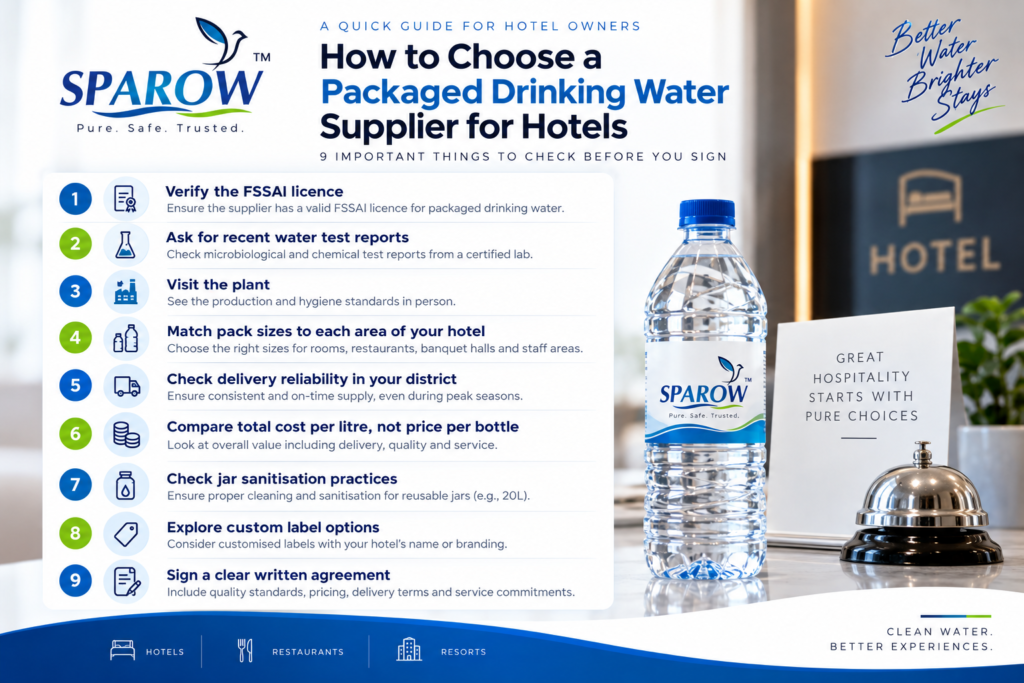
The short checklist:
- Verify the FSSAI licence
- Ask for recent water test reports
- Visit the plant
- Match pack sizes to each area of your hotel
- Check delivery reliability in your district
- Compare total cost per litre, not price per bottle
- Check jar sanitisation practices
- Explore custom label options
- Sign a clear written agreement
Why Your Hotel’s Water Supplier Matters More Than You Think
Water is the one product every single guest uses. Towels and toiletries vary, but everyone drinks water, and many guests drink the bottle in the room before they touch anything else.
That makes your packaged drinking water supplier for hotels one of your most visible vendors, even though guests never meet them.
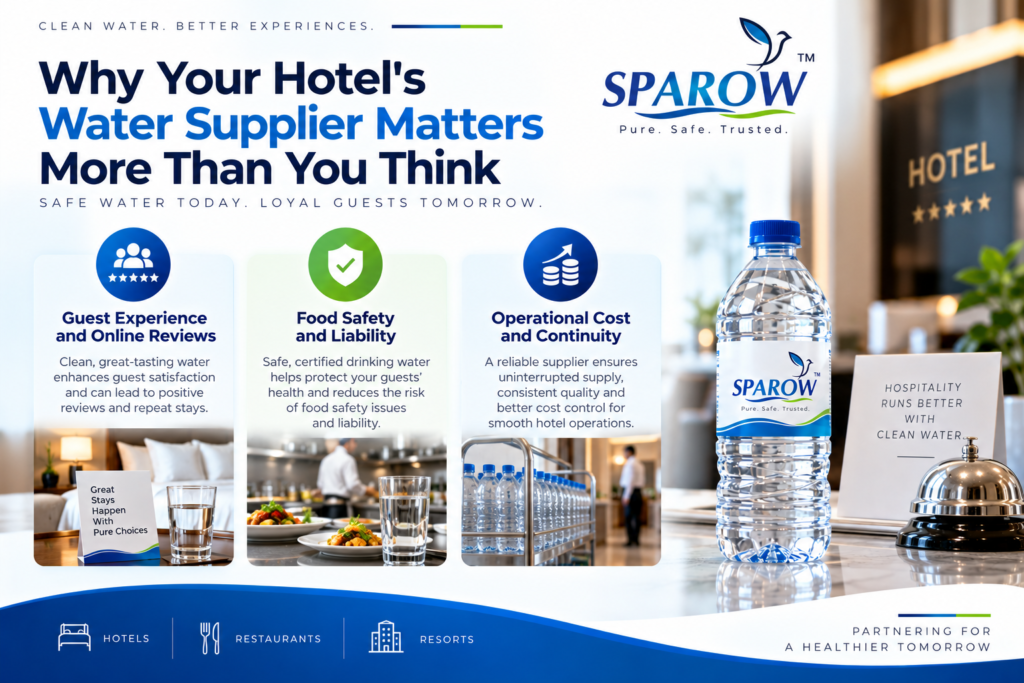
Guest Experience and Online Reviews
Guests rarely write reviews praising good water. However, they quickly mention a bad experience, such as an unsealed bottle, a plastic smell or a dusty jar at the restaurant counter.
On booking platforms, a single hygiene complaint can shape how future guests see your property. Consistent, clean, well-sealed hotel room water bottles quietly protect your reputation.
Food Safety and Liability
Water is used in your kitchen for cooking, making tea and coffee, washing produce and preparing juices. If the water is contaminated, the risk extends to every dish you serve.
Under food safety rules in India, hotels and restaurants are responsible for the safety of what they serve. Safe drinking water from a properly licensed supplier is your first line of defence.
Operational Cost and Continuity
A cheap supplier that misses deliveries costs more in the long run. Staff end up buying water from local shops at retail prices, and banquet hall water bottles run short at the worst possible moment.
Reliable supply keeps your costs predictable and your operations smooth, especially during wedding season and summer peaks.
What Is Packaged Drinking Water?
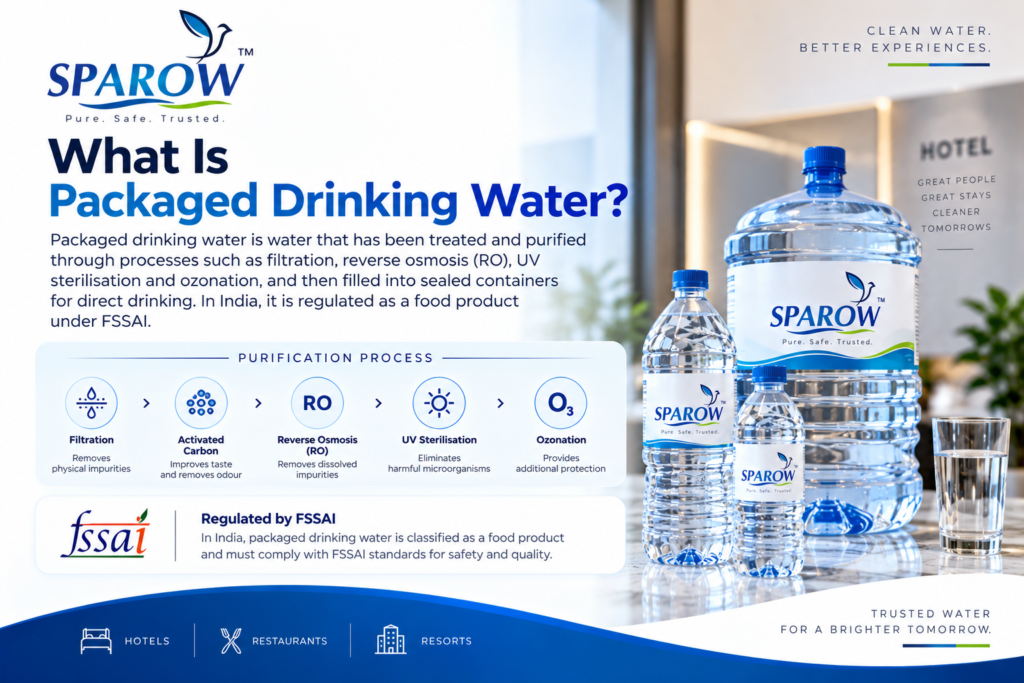
Packaged drinking water is water that has been treated and purified through processes such as filtration, reverse osmosis (RO), UV sterilisation and ozonation, and then filled into sealed containers for direct drinking. In India, it is regulated as a food product under FSSAI.
Many people use “mineral water” and “packaged drinking water” interchangeably, but they are different products.
| Feature | Packaged Drinking Water | Natural Mineral Water |
|---|---|---|
| Source | Any safe water source, treated | Specific underground natural source |
| Treatment | Purified (RO, UV, ozonation) | Minimal treatment to retain natural minerals |
| Mineral content | Adjusted during processing | Naturally occurring |
| Typical cost | More affordable | Premium priced |
| Best use in hotels | Rooms, restaurants, kitchens, banquets | Premium suites, fine dining, on request |
Many hotels search for a mineral water supplier, but they usually need purified drinking water for daily use and natural mineral water only for premium requests.
For most hotels, lodges and restaurants in Tamil Nadu, packaged drinking water is the practical, safe and cost-effective choice for daily use.
How to Choose a Packaged Drinking Water Supplier for Hotels: 9-Step Checklist
Use these nine steps as a working checklist when comparing vendors. Score each supplier as you go, and you will see the best option clearly by the end.
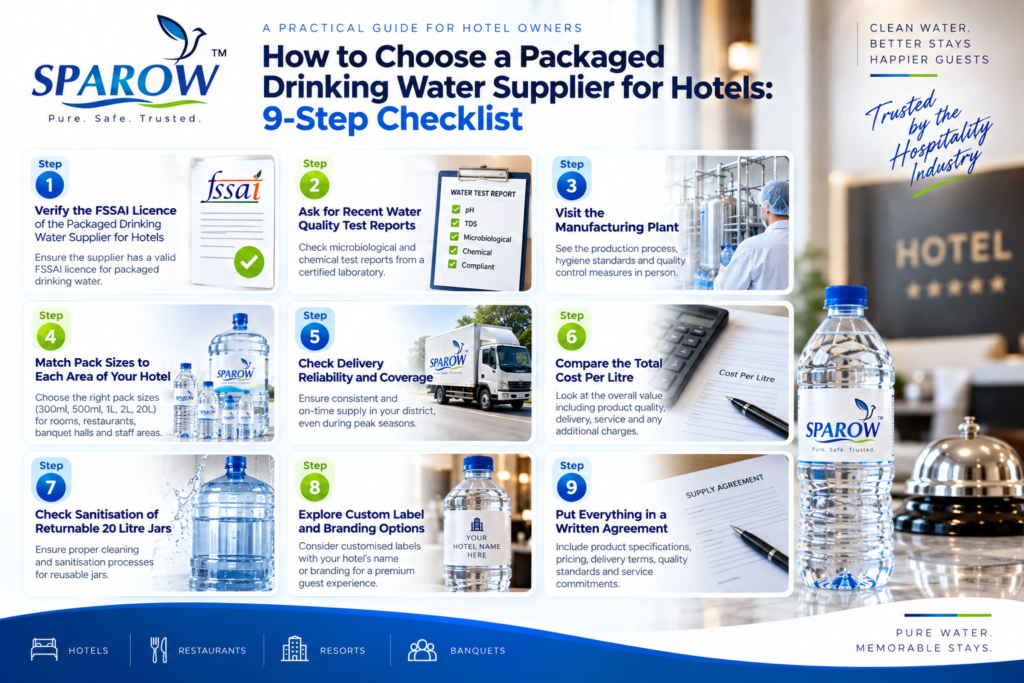
Step 1: Verify the FSSAI Licence of the Packaged Drinking Water Supplier for Hotels
This is the non-negotiable first step. Every packaged drinking water manufacturer in India must hold a valid FSSAI licence to produce and sell the product.
Ask the supplier for a copy of their licence. Then verify it yourself on the official FSSAI portal instead of trusting a photocopy.
What to Check on the Bottle Label
A genuine product label should clearly show:
- FSSAI logo and the 14-digit licence number
- Brand name and manufacturer name and address
- Batch number or lot number
- Date of manufacture and “best before” information
- Net quantity in litres or millilitres
- A tamper-proof sealed cap
If the licence number on the label does not match the licence the supplier shows you, walk away.
Step 2: Ask for Recent Water Quality Test Reports
A licence proves the business is registered. Test reports show what is actually inside the bottle.
Ask for recent reports from an independent, NABL-accredited laboratory. Reliable suppliers test regularly and will not hesitate to share results.
Key Parameters to Look At
- TDS (Total Dissolved Solids): affects taste and should be within permitted limits
- pH level: shows whether water is too acidic or too alkaline
- Microbiological tests: confirm absence of harmful bacteria such as coliforms and E. coli
- Chemical parameters: check for contaminants listed under food safety standards
If a supplier only offers an old report or an in-house report with no lab name, treat that as a warning sign.
Step 3: Visit the Manufacturing Plant
Nothing replaces seeing the packaged water plant with your own eyes. A water bottle manufacturer confident in their hygiene will welcome a visit.
What to Observe During a Plant Visit
- Clean, enclosed filling area with restricted entry
- Staff wearing hairnets, gloves and clean uniforms
- A visible, multi-stage purification line (sand filtration, carbon filtration, RO, UV, ozonation)
- Automatic or semi-automatic filling and capping
- Separate washing and sanitising area for returnable 20 litre jars
- An in-house testing lab or clear testing records
- Clean storage away from direct sunlight
A 30-minute visit often tells you more than a week of phone calls and brochures.
Step 4: Match Pack Sizes to Each Area of Your Hotel
Different areas of a hotel need different formats. A good bulk drinking water supplier for hotels offers a range that covers your full property, so you do not manage multiple vendors.
| Hotel Area | Recommended Pack Size | Why It Works |
|---|---|---|
| Guest rooms | 0.5 litre or 1 litre bottles | Convenient, sealed, easy to replace daily |
| Restaurant tables | 0.5 litre or 1 litre bottles | Hygienic for individual service |
| Banquets and events | 0.25 litre or 0.5 litre bottles | Reduces wastage from half-used bottles |
| Kitchen and staff areas | 20 litre jars | Lowest cost per litre for bulk use |
| Lobby and reception | 20 litre jar with dispenser | Easy self-service for guests and visitors |
| Travel and checkout | 1 litre bottles | Useful for guests going on day trips |
Before comparing prices, list the formats you need. This avoids a situation where one supplier looks cheaper only because they don’t offer what you actually use.
Step 5: Check Delivery Reliability and Coverage
Reliability and Coverage
A great product is useless if it doesn’t arrive on time. Delivery reliability is where many suppliers fall short.
When evaluating any packaged drinking water supplier for hotels, ask how many vehicles they run in your district and how they handle urgent orders. Ask other hotels in your town about their real experience.
Delivery Questions That Reveal the Truth
- What is your standard delivery frequency: daily, alternate days or weekly?
- How quickly can you deliver an emergency order?
- Who is my single point of contact?
- What happens during heavy rain or festival traffic?
- Do you have stock backup during summer demand spikes?
Step 6: Compare the Total Cost Per Litre
Many hotel owners compare the price per bottle and stop there. That approach often leads to hidden costs later.
Instead, calculate your total cost per litre. Include the product price, delivery charges, jar deposits, breakage or loss charges and any minimum order requirements.
Simple Cost Comparison Method
- List every pack size you will buy each month
- Convert all quantities into litres
- Add all charges the supplier will bill
- Divide the total monthly cost by the total litres
The packaged drinking water supplier for hotels with the lowest bottle price is not always the one with the lowest cost per litre. Always ask for a written quote with every charge listed.
Step 7: Check Sanitisation of Returnable 20 Litre Jars
Returnable 20 litre jars are the most cost-effective format for kitchens and staff areas. However, they are also the format most likely to cause hygiene problems.
Jars go to many locations and come back for refilling. Without proper washing, they can carry contamination into your kitchen.
Signs of a Good Jar Hygiene Process
- Jars are washed and sanitised before every refill
- Old, scratched or discoloured jars are retired regularly
- Each jar has a sealed cap and a fresh label or batch marking
- No visible algae, dust or scratches inside the jar
Inspect a few delivered jars against the light. Cloudy, scratched or greenish jars are a clear red flag.
Step 8: Explore Custom Label and Branding Options
Some hotels and resorts prefer water bottles with their own name or logo. This is often called private label or custom label water.
A branded bottle in every room becomes a small but constant reminder of your property. It also looks premium on restaurant tables and at wedding events.
Ask whether they offer custom label water bottles for hotels, what the minimum order quantity is, and how long printing takes. The manufacturer’s FSSAI licence details must still appear on the label.
Step 9: Put Everything in a Written Agreement
Verbal promises disappear when a supplier’s staff changes. A simple written agreement protects both sides.
What Your Supply Agreement Should Include
- Product types, pack sizes and prices
- Delivery frequency, timing and emergency order terms
- Jar deposit, return and damage policy
- Quality commitments and test report sharing frequency
- Price revision terms and notice period
- Complaint handling process and replacement of defective stock
- Termination conditions
How Much Packaged Drinking Water Does a Hotel Need?
Before you request quotes, estimate your monthly requirement in litres. This helps suppliers give accurate pricing and helps you plan storage space.
Every hotel’s usage is different. Use the simple planning formula below with your own figures.
Planning Formula for Guest Rooms
Daily room water (litres) = Number of rooms × Occupancy rate × Litres provided per room per day
Worked Example (Illustrative Only)
Suppose a 40-room hotel in Tirunelveli expects 70% occupancy and places two 0.5 litre bottles in each occupied room daily.
- Occupied rooms: 40 × 0.70 = 28 rooms
- Water per room: 2 × 0.5 = 1 litre
- Daily room requirement: 28 litres
- Monthly requirement: about 840 litres
These numbers are only an example. Replace them with your actual room count, occupancy and complimentary water policy.
Add Other Areas Separately
Estimate restaurant, kitchen, banquet and staff use separately, then add them together. Kitchens and banquet halls usually consume far more than guest rooms, so do not skip them.
Once you have a monthly total, add a buffer for summer and peak event months. Share this estimate with each supplier when requesting quotes.
Choosing a Packaged Drinking Water Supplier for Hotels in Tamil Nadu
Buying packaged drinking water for hotels in Tamil Nadu comes with conditions that generic guides don’t cover. Keep these regional factors in mind when choosing a packaged drinking water supplier for hotels in your district.
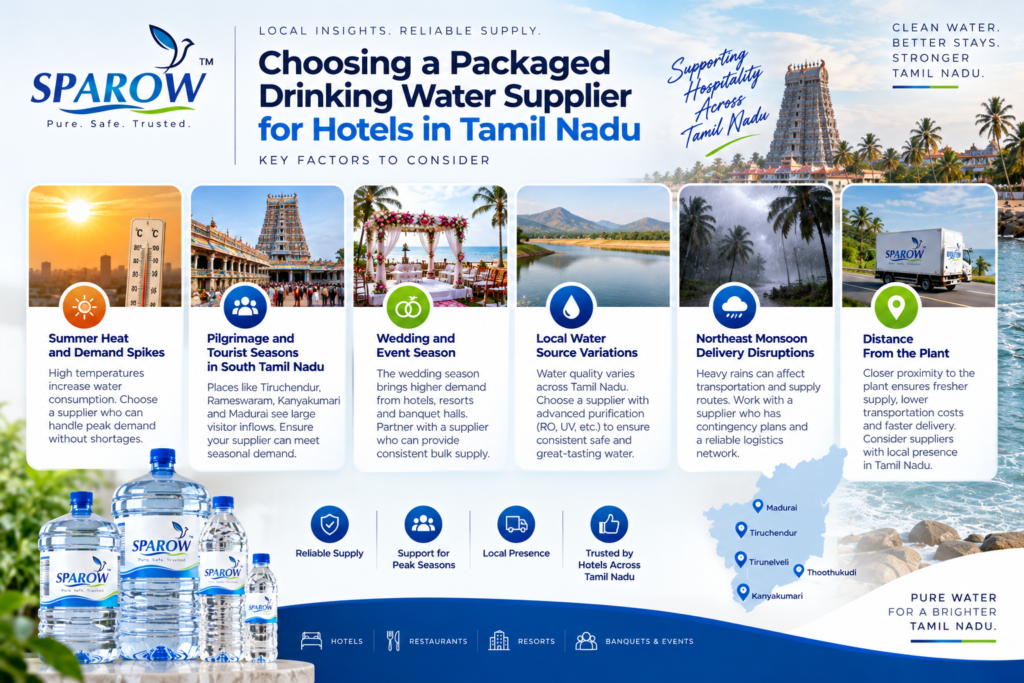
Summer Heat and Demand Spikes
From April to June, water consumption rises sharply across Tamil Nadu. Guests drink more, restaurants serve more chilled water, and many suppliers struggle to keep up.
Ask suppliers directly how they managed deliveries last summer. A supplier that runs short in May is not the right partner for your hotel.
Pilgrimage and Tourist Seasons in South Tamil Nadu
Towns such as Tiruchendur, Rameswaram, Kanyakumari and Madurai see heavy visitor flows during festivals and holiday periods. Hotels and lodges in these areas can see demand jump suddenly.
Choose a supplier with enough production capacity and vehicles to handle these surges. Plan festival orders at least a few weeks in advance.
Wedding and Event Season
Marriage halls and hotels with banquet facilities see large, one-day requirements during auspicious months. A single wedding can need hundreds of small bottles and multiple 20 litre jars.
Confirm whether the supplier can handle bulk event orders with short notice and deliver directly to the venue.
Northeast Monsoon Delivery Disruptions
From October to December, the northeast monsoon brings heavy rain to many coastal and southern districts. Waterlogged roads can delay deliveries for a day or more.
Ask your supplier about backup plans, and keep a small safety stock during these months.
Local Water Source Variations
Groundwater quality varies widely across Tamil Nadu, including differences in hardness and TDS between coastal and inland areas. This is exactly why proper multi-stage purification and regular testing matter.
A reliable manufacturer treats water to consistent standards, regardless of how the raw source water changes through the year.
Distance From the Plant
A supplier based close to your district can usually deliver faster and respond quicker to emergencies. For hotels in Tirunelveli, Thoothukudi, Tenkasi, Nagercoil and nearby towns, an established packaged drinking water distributor in South Tamil Nadu is a practical advantage.
Supplier Comparison Scorecard
Use this weighted scorecard to make hotel water procurement objective when comparing two or three shortlisted vendors. Score each factor from 1 (poor) to 5 (excellent), then multiply by the weight.
| Evaluation Factor | Weight | Supplier A | Supplier B | Supplier C |
|---|---|---|---|---|
| Valid FSSAI licence (verified) | 20% | |||
| Recent NABL lab test reports | 15% | |||
| Plant hygiene (after visit) | 15% | |||
| Delivery reliability | 15% | |||
| Total cost per litre | 10% | |||
| Pack size range | 10% | |||
| Jar sanitisation practices | 10% | |||
| Custom label and service support | 5% | |||
| Total Weighted Score | 100% |
How to use it: any supplier that cannot show a valid FSSAI licence should be removed before scoring. Safety is a qualifier, not a points category you can trade off against price.
This scorecard makes choosing a packaged drinking water supplier for hotels a clear, defensible decision you can explain to partners or management.
Local Manufacturer vs National Brand vs Distributor
Hotels usually choose between three types of sources. Each has strengths and trade-offs.
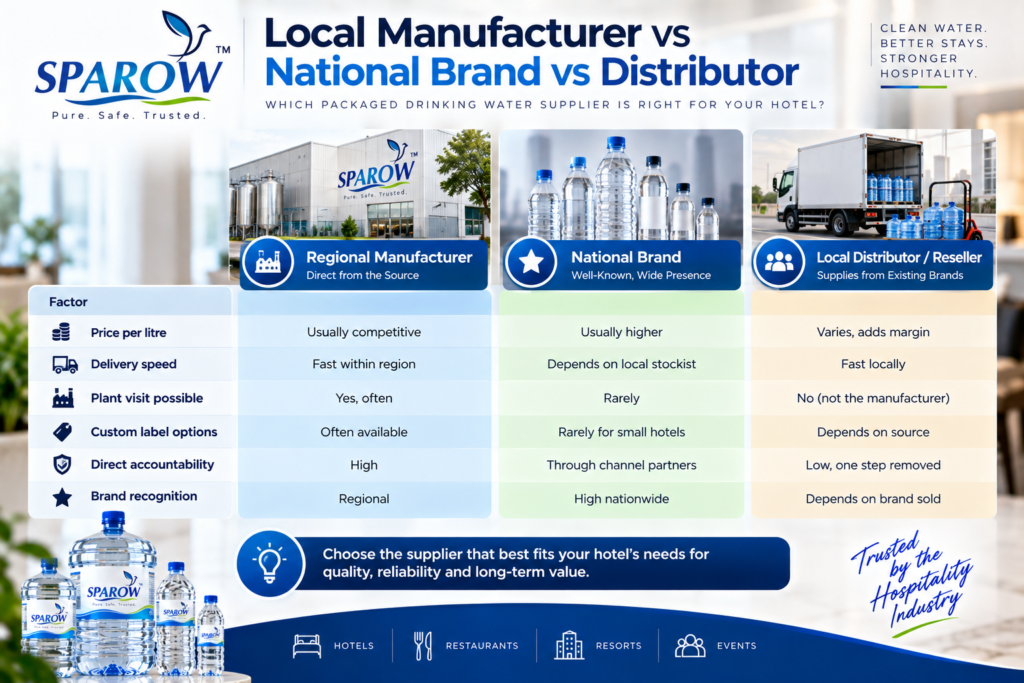
| Factor | Regional Manufacturer | National Brand | Local Distributor/Reseller |
|---|---|---|---|
| Price per litre | Usually competitive | Usually higher | Varies, adds margin |
| Delivery speed | Fast within region | Depends on local stockist | Fast locally |
| Plant visit possible | Yes, often | Rarely | No (not the manufacturer) |
| Custom label options | Often available | Rarely for small hotels | Depends on source |
| Direct accountability | High | Through channel partners | Low, one step removed |
| Brand recognition | Regional | High nationwide | Depends on brand sold |
For many hotels in South Tamil Nadu, a regional manufacturer offers the best balance. You get competitive pricing, direct accountability and a plant you can actually visit.
A national brand may suit premium hotels that want a familiar label for international guests. Distributors can work well for small volumes, but always verify the manufacturer behind the product.
7 Mistakes Hotels Make When Choosing a Water Supplier
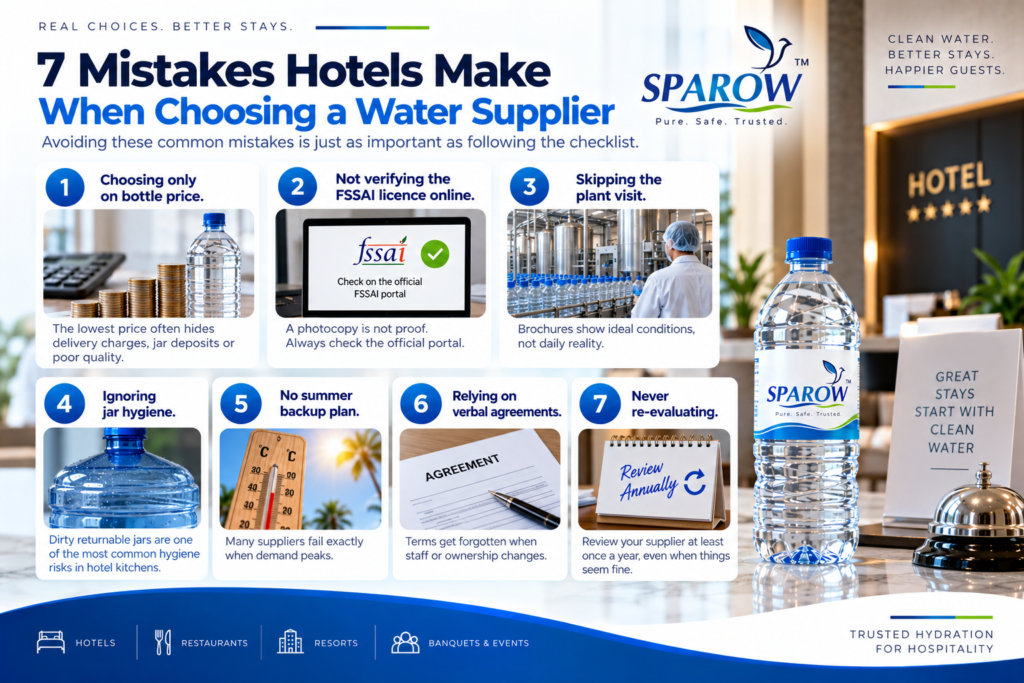
Avoiding these common mistakes is just as important as following the checklist.
- Choosing only on bottle price. The lowest price often hides delivery charges, jar deposits or poor quality.
- Not verifying the FSSAI licence online. A photocopy is not proof. Always check the official portal.
- Skipping the plant visit. Brochures show ideal conditions, not daily reality.
- Ignoring jar hygiene. Dirty returnable jars are one of the most common hygiene risks in hotel kitchens.
- No summer backup plan. Many suppliers fail exactly when demand peaks.
- Relying on verbal agreements. Terms get forgotten when staff or ownership changes.
- Never re-evaluating. Review your packaged drinking water supplier for hotels at least once a year, even when things seem fine.
Questions to Ask Before You Sign a Contract
Copy these questions into an email or bring them to your first supplier meeting.
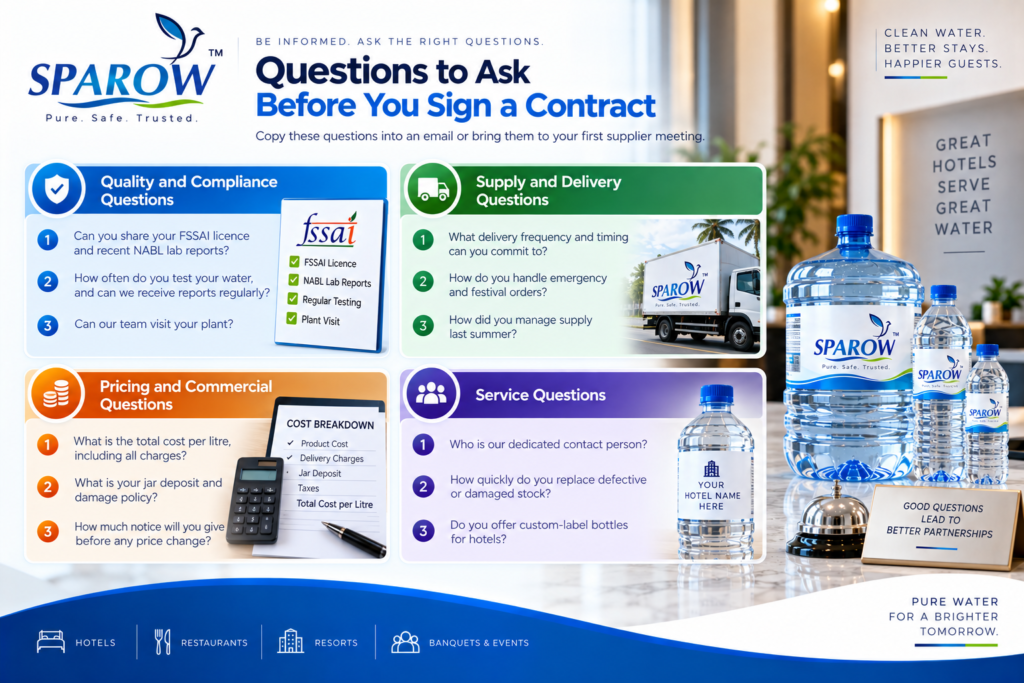
Quality and Compliance Questions
- Can you share your FSSAI licence and recent NABL lab reports?
- How often do you test your water, and can we receive reports regularly?
- Can our team visit your plant?
Supply and Delivery Questions
- What delivery frequency and timing can you commit to?
- How do you handle emergency and festival orders?
- How did you manage supply last summer?
Pricing and Commercial Questions
- What is the total cost per litre, including all charges?
- What is your jar deposit and damage policy?
- How much notice will you give before any price change?
Service Questions
- Who is our dedicated contact person?
- How quickly do you replace defective or damaged stock?
- Do you offer custom-label bottles for hotels?
Asking these questions is the most practical part of learning how to choose a packaged drinking water supplier for hotels. Clear, confident answers usually signal a reliable partner.
How to Store and Handle Packaged Water in Your Hotel
Even the best water can be spoiled by poor storage. Train your housekeeping, kitchen and store staff on these simple practices.
Storage Best Practices
- Store bottles and jars away from direct sunlight and heat
- Keep stock off the floor, on clean pallets or racks
- Keep water away from cleaning chemicals, fuel and strong smells
- Follow first in, first out (FIFO) so older stock is used first
- Check “best before” information during every stock count
Handling Best Practices
- Never refill used small bottles for guest service
- Discard any bottle with a broken or loose seal
- Clean water dispensers regularly as per the manufacturer’s instructions
- Inspect 20 litre jars for cracks or cloudiness before connecting them
- Record batch numbers of received stock, so you can trace any complaint
Good storage protects your investment and your guests. It also makes any quality complaint easier to investigate with your supplier.
Why Hotels in South Tamil Nadu Choose SPAROW
If you are looking for a trusted packaged drinking water supplier for hotels in South Tamil Nadu, SPAROW was built with hospitality and bulk buyers in mind.
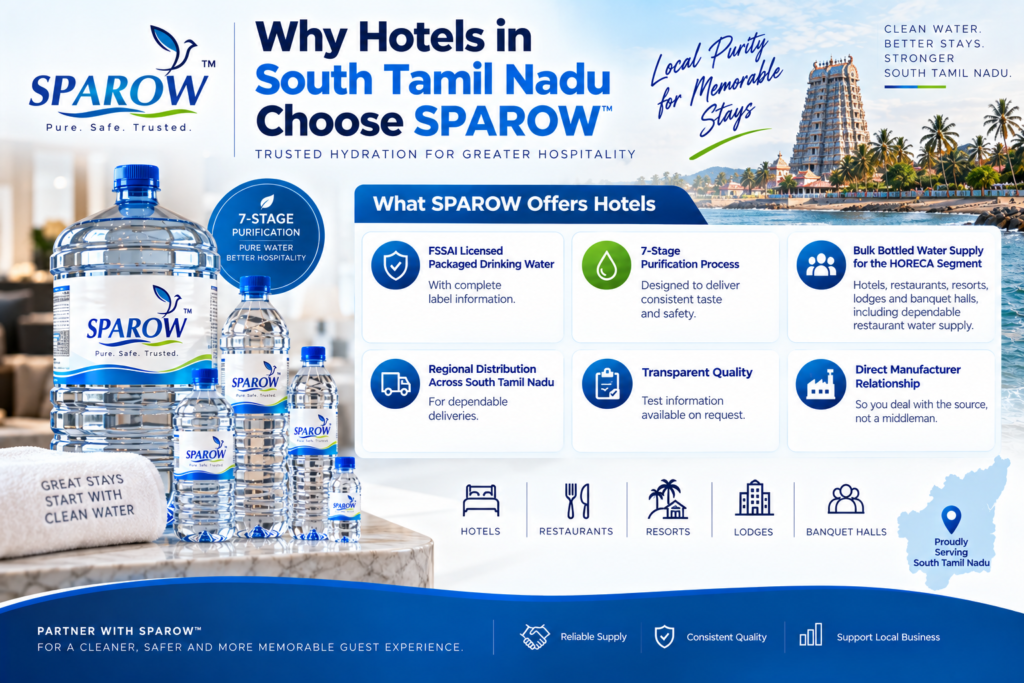
SPAROW is manufactured by RD Reigrow Private Limited, with its head office in Coimbatore and a distribution network focused on South Tamil Nadu.
What SPAROW Offers Hotels
- FSSAI licensed packaged drinking water with complete label information
- 7-stage purification process designed to deliver consistent taste and safety
- Bulk bottled water supply for the HORECA segment: hotels, restaurants, resorts, lodges and banquet halls, including dependable restaurant water supply
- Regional distribution across South Tamil Nadu for dependable deliveries
- Transparent quality, with test information available on request
- Direct manufacturer relationship, so you deal with the source, not a middleman
Built Around One Promise
SPAROW’s promise is simple: Pure. Safe. Trusted.
For a hotel, “every time” matters most. It means the same quality in the first bottle of the month and the last jar delivered during a busy wedding weekend.
Hotel owners and purchase managers are welcome to request a quote, ask for quality documents, or discuss supply for their property with the SPAROW team.
Conclusion
Knowing how to choose a packaged drinking water supplier for hotels comes down to a few clear priorities. Safety comes first, reliability comes second, and price only makes sense once the first two are confirmed.
Start by verifying the FSSAI licence and reviewing recent lab reports. Then visit the plant, match pack sizes to each area of your hotel, and compare the total cost per litre in writing.
For hotels in Tamil Nadu, plan ahead for summer heat, pilgrimage seasons, weddings and monsoon delays. A supplier with strong regional distribution will save you many stressful days.
The right packaged drinking water supplier for hotels becomes a quiet partner in your guest experience. If you run a hotel, restaurant or resort in South Tamil Nadu, speak with the SPAROW team to discuss your requirements and get a clear, written quote.
FAQs
1. How do I choose a packaged drinking water supplier for hotels?
Start by verifying the supplier’s FSSAI licence on the official FSSAI portal. Next, ask for recent water test reports from an NABL-accredited lab and visit the manufacturing plant. Then check whether they offer the pack sizes your hotel needs, such as 0.5 litre and 1 litre bottles for rooms and 20 litre jars for kitchens. Finally, confirm delivery reliability in your district and get all pricing and service terms in a written agreement.
2. Is an FSSAI licence mandatory for packaged drinking water?
Yes. Packaged drinking water is treated as a food product in India, so manufacturers must hold a valid FSSAI licence. The label should display the FSSAI logo and the 14-digit licence number. Hotels should verify this number on the official FSSAI website rather than relying on a photocopy. Buying from an unlicensed supplier creates food safety risk and potential liability for your hotel.
3. What is the difference between packaged drinking water and mineral water?
Packaged drinking water is water from a safe source that is purified using methods such as RO, UV sterilisation and ozonation. Natural mineral water comes from a specific underground source and keeps its naturally occurring minerals with minimal treatment. Packaged drinking water is generally more affordable, which makes it the practical choice for daily use in hotel rooms, restaurants, kitchens and banquets.
4. How can I check if a packaged water bottle is genuine?
Check the label for the FSSAI logo and licence number, brand and manufacturer details, batch number, manufacturing date and “best before” information. The cap should be sealed and tamper-proof. Verify the licence number online. Avoid bottles with loose caps, faded or misspelt labels, missing batch details or unusual taste or smell, and report suspicious products to your local food safety officer.
5. What bottle size is best for hotel rooms?
Most hotels use 0.5 litre or 1 litre bottles in guest rooms. The 0.5 litre size reduces wastage and suits short stays, while 1 litre bottles work well for families, longer stays and hot summer months. Many hotels in Tamil Nadu place two 0.5 litre bottles per room daily. Choose based on your guest profile, room type and complimentary water policy.
6. How much drinking water does a hotel need per month?
It depends on your room count, occupancy, complimentary water policy and food and beverage operations. Use this formula for rooms: number of rooms × occupancy rate × litres per room per day, then multiply by 30. Estimate restaurant, kitchen, banquet and staff usage separately. Add a buffer for summer and event months, and share the total in litres with suppliers when requesting quotes.
7. Are 20 litre water jars safe for hotel kitchens?
Yes, 20 litre jars are safe when the supplier washes and sanitises every jar before refilling and retires old or scratched jars regularly. Each jar should arrive with a sealed cap. Inspect jars against the light for cloudiness, scratches or green tints. Store them away from sunlight and clean dispensers regularly. Poorly maintained jars are a common hygiene risk in commercial kitchens.
8. Can hotels get custom-branded water bottles?
Many manufacturers offer custom or private label bottles with your hotel’s name and logo. Branded bottles look premium in rooms, restaurants and at weddings, and they reinforce your brand with every guest. Ask about minimum order quantities, printing lead times and label design options. The manufacturer’s FSSAI licence details must still appear on the label as required by food safety rules.
9. How often should a hotel review its water supplier?
Review your supplier at least once a year, and after any serious complaint or supply failure. Check whether test reports are still recent, deliveries were on time during summer and festival seasons, and pricing is still competitive. Use a weighted scorecard to compare your current supplier against one or two alternatives. Regular reviews keep quality high and prevent complacency.
10. Why should hotels in South Tamil Nadu choose a regional supplier?
A regional manufacturer usually delivers faster, responds quicker to emergency and festival orders, and handles monsoon disruptions better than a distant supplier. You can visit the plant, deal directly with the manufacturer and often access custom label options. For hotels in Tirunelveli, Madurai, Thoothukudi, Kanyakumari and Tenkasi, a supplier like SPAROW with South Tamil Nadu distribution offers practical reliability.
Looking for a reliable packaged drinking water supplier for your hotel in South Tamil Nadu?
SPAROW supplies FSSAI licensed packaged drinking water for hotels, restaurants, resorts and banquet halls, backed by a 7-stage purification process and regional distribution.
👉 Request a Quote — share your monthly requirement in litres and get clear pricing
👉 Talk to Our Team — contact@rdreigrow.com
SPAROW — Pure. Safe. Trusted. Every Time.
Key Takeaways
- Verify the FSSAI licence online before anything else
- Ask for recent NABL-accredited lab reports and visit the plant
- Match pack sizes to rooms, restaurants, banquets and kitchens
- Compare total cost per litre, not bottle price
- Plan for Tamil Nadu summers, pilgrimage seasons, weddings and monsoon delays
- Put pricing, delivery and quality terms in a written agreement